Search This Blog

Saturday, January 8, 2022

Storytime

 Picture the dinner you've been invited to.  You've been welcomed and prayed thanksgiving and praises.  Now our host is going to tell you some stories.  I picture everyone sitting around the table waiting for dinner to be served and talking.  The host has center stage and he's a storyteller. 

Jesus has invited us to the Passover Seder and His stories are the scriptures.  We call this part of the Mass, the Liturgy of the Word.  The reader or lector goes to the ambo (Latin for pulpit or lectern) and reads from a book of scriptures called the Lectionary. A good lector won't just read, he will proclaim.  When I read at Mass I prepared my readings beforehand.  I didn't want to stumble or mispronounce names.  I also wanted my tone to match the tone of the scriptures. The First Reading is from the Old Testament. When I came to the end of the scripture, I pronounced the acclamation The word of the Lord, and all replied, Thanks be to God.

After the First Reading is a Psalm.  This should be sung. In place of a Cantor leading the congregation in singing the responsorial psalm, the lector would simply read it.  When I was the Lector, I read the psalm.  No way I was going to sing.  This is a psalm, not a penance.

The Second Reading is from the New Testament.  Once again, when the lector finished this reading, the acclamation  The word of the Lord, and all replied, Thanks be to God.

Upon finishing the readings, the lector returns to his seat.  The congregation will stand and the deacon or priest will go to the ambo to read the Gospel. The Gospel is from one of the four Evangelists: Matthew, Mark, Luke, or John.  This is the high point of the Liturgy of the Word because the Gospels tell the life and teachings of Jesus.  It is so special, you will see the people do something with their hands on their foreheads, mouth, and chest.  What are they doing?  They are saying a prayer to remember the Gospel's teachings.  The prayer copies what is prayed before the recitation of the Gospel.  

The gesture is a direct imitation of what the deacon (or priest when a deacon is not present) is instructed to do before he recites the words of the holy Gospel. The Roman Missal states, “Then, with the thumb of his right hand, he makes the sign of the cross first on the book at the beginning of the Gospel to be read, and then on himself on the forehead, mouth, and breast.” 

Following, the people take their thumb and make the sign of the cross on their own forehead, mouth, and breast, praying: 

May the Word of the Lord be on my mind, on my lips, and in my heart.
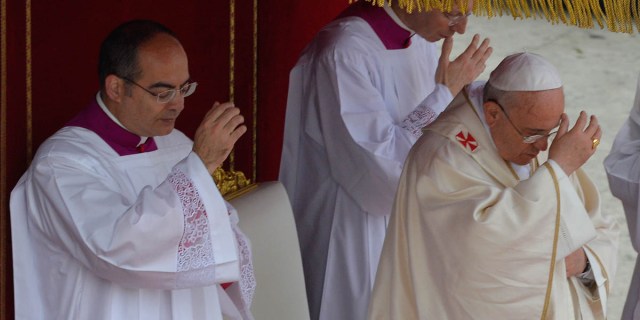

After the Gospel reading, the acclamation The Gospel of the Lord is said.  Everyone responds with Praise to you, Lord Jesus Christ, and sits down to listen to a homily. The homily should focus on the Readings drawing lessons from them to help us be faithful to Jesus' call to holiness.

A Profession of Faith follows with everyone reciting a creed (statement of faith).  The Liturgy of the Word concludes with the Prayer of the Faithful, where we all ask God, on behalf of the Church, and the world to hear our intercessions. 

That's it.  

We sit and a collection is taken.  


Friday, January 7, 2022

Ready to Celebrate

 Mass is a religious ceremony filled with scriptural references.  As we have prepared ourselves to participate in the celebration of the Mass by understanding what goes on, praying, and having the correct disposition, we stand to sing the entrance hymn and respond to the Mass celebrant's greeting and prayers.

The entrance hymn expresses the unity of the people with their variety of voices joining together in communion to make the one voice of the church.  St. Augustine says singing is praying twice--so pray as best as you can.  God gave you your voice so let Him hear it!

When the procession reaches the altar, the Mass celebrant will greet the congregation.  We then collectively ask God to forgive our failings.  The priest will bless us:
May almighty God have mercy on us
forgive us our sins,
and bring us to everlasting life.
Amen.
(My "cloistered brothers" bless themselves after this prayer because they consider this a minor exorcism.)  Me too!!

Next, we praise God by singing the Gloria.  

Glory to God in the highest. And on earth peace to men of good will. We praise You. We bless You. We adore you. We glorify You. We give You thanks for Your great glory. O Lord God, heavenly King, God the Father almighty. O Lord Jesus Christ, the Only-begotten Son. O Lord God, Lamb of God, Son of the Father: you Who take away the sins of the world, have mercy on us. You Who take away the sins of the world, receive our prayer. You Who sit at the right hand of the Father, have mercy on us. For you alone are holy. You alone are the Lord. You alone, O Jesus Christ, are most high. Together with the Holy Spirit in the glory of God the Father. Amen.

Picture Jesus, or yourself hosting dinner.  You come in, greet and praise God and your guests.  This is exactly what we've done.

Let's sit now and listen to what God has to say.


Thursday, January 6, 2022

Ready, Set, Go

 Many think the Mass is confusing.  I haven't even got there yet.  For the last three days of posting, I've just got myself in the mood, the grove, the correct disposition to pray the Mass.

Following St. Dominic I should, to the best of my ability, understand what I will see before me.  I will be prepared for all the Readings.  Like St. Catherine of Siena, I've dialogued with God about what's going on with me, and like Blessed Lataste, I'm open to all.

To make it simple, there are three parts to the Mass.  Think of the Mass as a supper.  It is the representation of the Last Supper, after all.  Jesus walks in the room, meets and greets and goes over to the table.  The priest in an entrance procession will head to the table/altar.  He greets everyone and prays that we are all worthily prepared for Mass.

Isn't this what we do ourselves at special dinners?  We come in and the host greets and wishes us well and hopes that the upcoming meal will bring us all together.

Depending on the day, it may be a special occasion, the entrance may be elaborate and singing may accompany the entrance, but essentially we've begun.


Wednesday, January 5, 2022

The Way to Mass is Thru Your Heart III


This is Blessed Jean-Joseph Lataste, OP visiting inmates.  He was a fairly new preacher when he was assigned to preach to women prisoners in Cadillac, France, 1864.  He didn't want to do it.  Don't the rookies always get the worst assignments?  He thought he would be wasting his time.  The prisoners wouldn't want to do listen to him; they probably would be rude and disrespectful. He also was afraid of these women.  After all, he was a product of his time, which considered these women not much above low life.   But thinking of how Jesus was treated, he tried to act like Jesus would.

Pere Lataste was in for a surprise.  Not only did he convert the prisoners, but they also converted him! He was the first to be converted.  They did listen to him, intently.  Their confessions brought him to tears. 

He eventually founded a community of former converted women prisoners.  They are called the Dominican Sisters of Bethany.  They not only work with prisoners, but orphans, handicapped, children, and the disadvantaged.  Their cornerstone, like St. Dominic himself founded, was contemplation.  Many of the sisters are contemplative nuns, but there are active branches of apostolic sisters, also.

How Blessed Lataste did this is the same method we are to approach Mass.  We go to Mass in the first place because Jesus modeled obeying the religious rules.  We go to Mass.  But Lataste was open to conversion, and so we approach Mass, not in a bad mood--"Let's get this over with,"  but open to what Jesus is going to show us.  

We won't be judgemental.  We will look for surprises. Pray for all to develop a relationship with God.

Monday, January 3, 2022

The Way to Mass is Thru Your Heart II


St. Catherine of Siena is another "go to" model to emulate when it comes to learning to love the Mass.  Since she was a child she talked to God.  Talking = Praying.  Her mystical conversations are in a book called the Dialogue.  She talked to God constantly.  The central image in the Dialogue is Jesus as a bridge between God and us.  The bridge is over a river (think "sin").  Sin keeps us from God.  We need to cross the bridge. Follow Jesus over--talk to Him--take His hand.  Picture this before Mass.  Take Jesus' hand and let Him lead you over the bridge.  The two of you can stand arm in arm, contemplating and talking about receiving the Eucharist.  What was it like at the Last Supper?  Are you there?  Where are you sitting?  Whom are you talking to? What are you eating?  What does the food smell like?  What is the noise level?  What do you hear?  Is there music?  Is singing part of this celebration? 

Do you see Judas?

What going thru your mind?  

What is Jesus eating?

Is He smiling?  (at you?)

You are still in the preparation stage of going to Mass.  Constantly talk to God.  Walking or driving to Mass can be a constant dialogue.  Kneeling in the pew--"I'm b-a-c-k." Don't lose touch.  Stay in contact.  Celebrating Mass with Jesus, what can be better than that?

Sunday, January 2, 2022

The Way to Mass is Thru Your Heart

 A Biblical Way of Praying the Mass by Father Tim Gallagher explains how to get more out of the Mass.  I was listening to the first part this morning.  Father Tim suggests we take a favorite saint and imagine how that saint prepared himself for Mass.

I imagined St. Dominic Guzman.  He would pray and study.  How would I approach the Mass this way?  It's a good idea to imagine St. Dominic because he wouldn't just "go" like some people do and then wonder what was going on. I once brought someone to Mass and sat them in front of the Tabernacle hoping Jesus would lead them.  The man took out paper and pen and started taking notes; he expected a long preaching service.  Another person, after attending a Catholic wedding said she was glad she wasn't Catholic because her knees hurt and just got comfortable sitting when she had to stand up again.

You can't just walk into Mass and love it.   St. Dominic would say "study" it.  There are many books written about the Mass: its connection to Jewish traditions, its Biblical origins, and its historical development from the Last Supper.  There are missals to follow the Mass in the pews.  There are even books for children.  You need to understand what you are looking at.

There is a part of the Mass that really needs weekly study, and that's the Liturgy of the Word.  You can prepare yourself to listen to the Readings before you attend Mass.  I myself belong to a weekly Scripture Sharing group that does just this.  It is a great help to appreciate the Liturgy of the Word.

But you want to love the Mass.  Understanding it is the first and most necessary step.  St. Dominic would also pray.  He would probably sing, "Come Holy Spirit".  He would pray to be worthy to receive the Eucharist, pray for focus, pray for appreciation, thanksgiving, and worthiness.  

All this is done before Mass.  The readings for sure are prepared.  The praying could start while we are dressing for Mass, or driving, and/or definitely kneeling in our pew prior to Mass.

It's the preparation that turns the heart towards the right disposition to focus on the Mass.


Saturday, January 1, 2022

My 2021 Favorite Books


I'll give you my top five:

1.  Crow Lake by Mary Lawson

2.  Count the Ways by Joyce Maynard

3.  The Sabbatical by Michael D. O'Brien

4.  The Four Winds by Kristin Hannah.  

5  A Gathering of Old Men by Ernest J. Gaines

Gandhi's Seven Deadly Sins

 Wealth without work. Pleasure without conscience. Knowledge without character. Commerce without morality. Science without humanity. Worship...