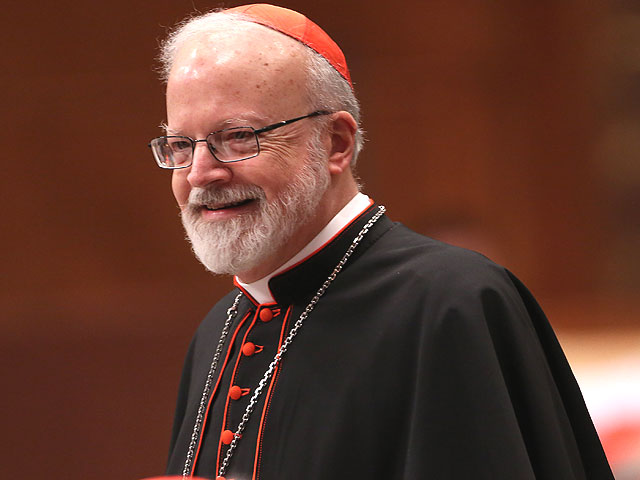
Many churches are opening tomorrow. Our Cardinal Archbishop, Sean Patrick O'Malley has written a letter for all the faithful.
May 26, 2020
Letter to the Faithful
So much of modern life has been upended by the pandemic. Social distancing keeps us from the routine contact that we took for granted for a lifetime. But the pandemic has had an almost opposite effect on family life. Modern families have, up until now, developed social distancing into an art form.
A generation ago, the typical American middle-class family had their own home. Often, there were many children, but one automobile, one telephone, one television set and one or two bathrooms. Family life was about being together and sharing. Meals were a family affair. Children even came home from school for lunch.
The evening meal was a time when the whole family gathered to enjoy a good home-made meal and to bond with each other through all the back-and-forth that took place at the dinner table. The modern family, often a one-parent family, is pulled in a thousand directions by different work schedules, extracurricular activities, organized athletics, addiction to social media and many other aspects of modern life that promote isolation and individualism.
Enter the pandemic, and suddenly being part of a family is like living in a treehouse on Treasure Island. It is a challenge and an opportunity. It can be a time for us to reconnect with our families, to get to know each other better, to overcome our innate selfishness and learn how to give, how to forgive and how to be part of a community.
One of the documents of the Second Vatican Council, “Lumen Gentium,” describes the family as the domestic Church. Pope John Paul II often spoke about the family as the domestic Church. He outlines the four tasks that each family should strive to accomplish: 1) Forming a community of persons, 2) Serving life, 3) Participating in the development of society, and 4) Sharing in the life and mission of the Church.
I know this can all sound kind of daunting when discussions over who is going to wash the dishes and empty the garbage can take center stage. The lofty goals of the Christian family can be achieved only where the family is a school of love and a sanctuary of life. For many people, the stay-at-home order was an invitation to rebuild family life.
Suddenly, many parents who used to struggle to get their children dressed and ready for school each day have morphed from school bus driver to teacher, counselor and recreation director. Parents who were so often critical of teachers, coaches and school personnel have discovered how short their child’s attention span can be. The helicopter has crashed.
One of the challenges of working and studying remotely is to avoid treating every day like a Saturday. We need the discipline to map out a schedule that will allow us to have a productive and satisfying day. Hopefully, families will be able to recoup the meal as a time for conversation and sharing without the intrusion of television and smartphones.
Children need to understand that the inconveniences of social distancing are an expression of a desire to protect the vulnerable. Love is always about making sacrifices for others.
Just as parents are thrust into a new role of teaching mathematics, earth science and social studies, I hope the parents will now embrace their role as the chief catechist for their children. I am always edified that our Catholic people, even those who are not great churchgoers, still have a desire for their children to receive religious education. Parents are content to entrust the religious formation of their children to the parish catechist.
We all owe a great debt of gratitude to the parish staff and volunteers who dedicate so many hours to preparing and imparting classes on the faith. Passing on the faith to new generations is one of the primary responsibilities of every parish community. But the pandemic brings home to us that religious education is primarily the responsibility of the family.
Social distancing makes it difficult to give our young people the religious formation that we all want them to have. At the same time, this is an opportunity for parents to exercise their special role in passing on the faith to their children. Although it is not something we do spontaneously, we need to learn to talk about our faith, to share our ideals and to pray together. Religious formation is not just about imparting information; it is about molding people’s hearts, helping them to have a relationship with Jesus Christ and to embrace a life of discipleship in a community of faith. Our religious formation is to help us to discover how much God loves us, who we are, why we are here, and what is our mission and purpose. An important part of discipleship is discovering our own vocation, the special way that God is calling us to live a life of service, to make a gift of ourselves and to share the treasure of faith with those around us, to build a civilization of love rather than greed.
This week, the Catholic Church is reliving liturgically that first novena: the nine days between Ascension Thursday and Pentecost Sunday, when the Apostles with the Blessed Virgin and the disciples were sequestered in the Cenacle. It was an exercise in social distancing because of the fear of persecution, but it was also a very powerful experience of shared prayer that prepared the community of faith for the transformation of Pentecost with the outpouring of the Holy Spirit.
I hope that the experience of being thrown together will not be wasted on our families, but rather that it will be a time of intense experience of community and solidarity, renewal in prayer and a deep sense of identity. May our days locked in the Cenacle help us to emerge as stronger, faith-filled disciples ready to embrace our mission to carry on the work of Christ in the world.
In the history of salvation, the great plagues of Egypt were a preface for the liberation of God’s people. I hope that this modern plague will lead to our liberation from a culture of death into a Promised Land of people ready to make sacrifices for each other and who are deeply aware of how much we need God and one another. Social distancing can teach us that we are meant to be part of something bigger than ourselves.
When Pope Francis went to Lampedusa shortly after his election as Pope, he called on everyone to overcome the globalization of indifference, to be a people who care about people, not just about money and having fun. The text that the Holy Father used was from Genesis, where God asked Cain: “Where is your brother?” Cain answers God: “I do not know. Am I my brother’s keeper?” The pandemic has forced us to stop pretending that we are not connected, that we have no responsibility for the suffering of others and that, somehow, we can make our own life and happiness without reference to the rest of humanity.
Pope Francis, in his encyclical “Laudato Si,” refers to this planet as our common home; it is more than just a metaphor. If you live in the penthouse suite of a 30-story apartment building, and there are several apartments on the first, second and third floors that are in flames, you cannot be nonchalant about the situation. The Gospel of Life in the Church’s social doctrine is a treasure trove of wisdom that can help us to find paths forward for humanity crippled by individualism, materialism and greed.
The temptation in a time of pandemic is to seek an anesthetizing distraction and entertainment rather than taking the time to examine the meaning of this pandemic and its repercussions for the future. Typically, it is only when we lose something or someone we care about, that it dawns on us how important that person, experience or treasured possession was for us. Watching them slip away and disappear from life is often a rebuke for having taken them for granted.
When I was growing up, the Church observed a very strict Communion fast. We could not eat or drink anything — not even water — from midnight before we were going to receive Holy Communion. In the Catholic school that I attended, there were covers placed over the water fountains to remind people not to break the fast. Some people were afraid to brush their teeth in the morning for fear that they might swallow a little water and thereby be ineligible to receive the Eucharist.
At one point, the Holy Father changed the discipline so that water would never break the fast, and later, the fast was changed to three hours before receiving Communion. More recently, Pope Paul VI further mitigated the fast to one hour before receiving Communion. I presume many people are unaware of the fast because it has been reduced to such a short period.
The practice of the Communion fast dates back to the 4th century and, indeed, St. Augustine claimed that it went back to the time of the Apostles. The motivation for the Communion fast was always presented as being out of respect for the Lord’s Body and Blood. St. Thomas Aquinas said that the fast responded to the Lord’s injunction, “Seek first the kingdom of God.” Some spiritual writers suggested that the pre-Communion fast was a way of ritualizing the spiritual hunger that should characterize all those who gather at the Eucharistic table.
The pandemic has brought a new kind of Eucharistic fast to our Church, which has made it difficult for many of the faithful to receive the Sacrament. We can only hope that this forced Communion fast might result in a deeper hunger for the reception of Holy Communion.
Being a disciple of Jesus is always about being part of a community — the community that gathers around the Eucharist. May we never take this great gift for granted. In the Eucharist, Jesus makes a gift of Himself to us. At the first Mass, Jesus made it very clear that the Eucharist is the key to understanding discipleship. Jesus gives us the gift of Himself and urges us to wash each other’s feet and to love each other the way he loves us, to the point of making a gift of ourselves.
Some of our brothers and sisters are in solitary confinement. Our consolation is that we are never really alone in the Body of Christ. Cardinal Van Thuan spent 13 years in a communist prison, nine years in solitary confinement. He documents his experience in the powerful book: “The Road to Hope.” In the midst of the isolation of the pandemic, we must find hope in Jesus Christ’s promise that he would be with us always. Social distancing cannot destroy the spiritual accompaniment that is born at the moment of our Baptism and connects us to the Lord and our brothers and sisters in the faith.
May social distancing make us more aware of our vocation to community and solidarity; may our forced fasting from Holy Communion augment our hunger for the Bread of Life; may all our homes be like the Cenacle where the disciples were united with Mary in prayer waiting for Pentecost. May our experience of staying at home be not so much a house arrest but a retreat that will allow us to experience the peace and love, simplicity and hospitality of the Holy Family at Nazareth.
 It tells of black garden ants using social distancing to combat outbreaks of infectious disease. Workers in ants' colonies are divided into nurses, which care for inside the nest, and foragers, which collect food outside and are the ones who pick up pathogens.