Search This Blog

Showing posts with label historical fiction. Show all posts

Wednesday, August 27, 2025

Trouble on the Plantation

 The Kitchen House by Kathleen Grissom is a book club recommendation.  This book will appeal to those who love historical fiction, family relationships, and tense drama.  It can be a page turner.  The setting is the South around 1800.  Lavinia's family was on route to America from Ireland. Her parents die and Lavinia and her brother are indentured to different people to pay for the family's passage.  She lives with the ship's captain's family on a typical southern plantation.

Eventually, she fits in place, although not part of the owner's family.  She is more part of the slave's family.  She works in the kitchen and grows close to her enslaved family and they love her back.

The reader will see how the slaves were treated and the conditions they tried to overcome.  The owner's family also had troubles.  The father was too often away.  The mother was ill.  The daughter accidently dies.  The son is mistreated by his tutor.

When the plantation owner dies, the mother is put in an insane asylum and Lavinia is sent to live with the mother's relatives.  Here she thrives until she is married to Marshal, the son of the plantation owner.

Life is ironic, here.  Lavinia returns as the mistress of the plantation.  Her marriage, however, is not happy, to say the least. Marshal is abusive and a drunk. Lavinia identifies more with her enslaved family than with Marshal.

Upheaval comes.  Tragedy strikes.  Lavinia is fine but things will never be the same.


Sunday, April 6, 2025

A Real Life Heroine

 Another book review: The Frozen River by Ariel Lawhon is historical fiction.  The chief protagonist is Martha Ballard, a real person who lived in Maine, 1789.  Her family is real, probably taken from a census, but the story, a mystery, a thriller, a good tale.

The setting is next to the Kennebec River.  Martha is a midwife, but does quite a bit of doctoring, too.  When the minister's wife is raped, Martha takes her side.  Surprisingly, or maybe not, for those times, the people in the village, are not too sympathetic.  Her husband was not liked, and the villagers want him out.  Unfortunately, the raped yielded a baby.  Martha delivers in more ways than one.

The frozen Kennebec also yields a frozen body--one of the rapists.  Since he was accused, no one puts too much thought into it.  Good riddance.  But Martha sees that the victim was beat-up and hung.  The clues as to the perpetrators are throughout the chapters.  

Justice does prevail and life goes on.  Ariel Lawhon writes with compassion and a sense of history.  


Monday, March 6, 2023


Salt to the Sea by Ruta Sepetys is a historical novel.  The reader views the story through four eyes: Joana, a Lithuania nurse.  Emilia, a fifteen-year-old pregnant Pole, raped by the Russians, Florian, a German apprentice art restorer who didn't want to cooperate anymore.  Alfred, a deranged German sailor.

Everyone has heard stories of what the Russians do to their occupied countries.  They raped their way through Europe in WWII.  Poor Emilia is traumatized. She would have been raped again, were it not for Florian, who saved her.  After that, Emilia sticks to Florian like white on rice.  Joana runs hither and thither doing whatever to help.  Alfred is a haunting, dangerous creep.

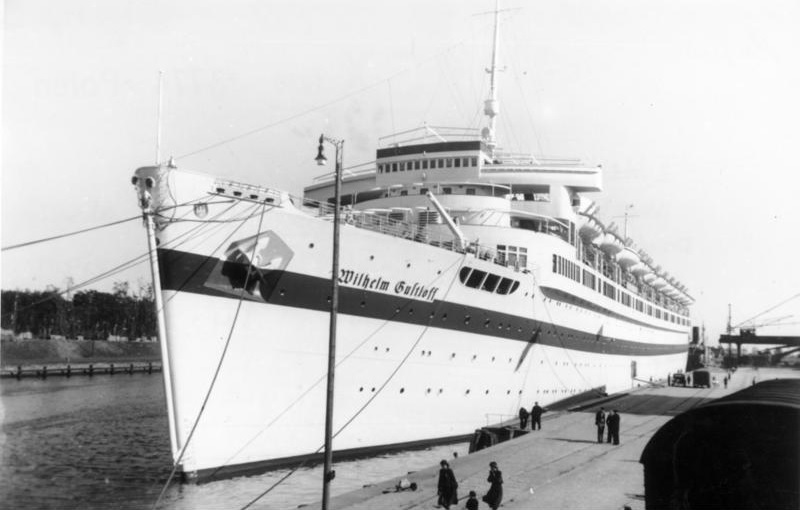
They are all fleeing the Russians.  They want to get on a boat and get away as fast as they can.  The four protagonist, plus a little boy, all end up on the ship, Wilhelm Guftloff.


The ocean liner looks formidable, doesn't it?  So did the Titanic.

It was sunk by Russian torpedoes.  Too many drown including Alfred and Emilia.  Emilia had her baby on ship and the newborn survives, adopted by Joanna and Florian, plus the little boy.  

Heart wrenching, exciting and a good read.  It's history and it can be stranger than fiction.  My only thought is a question.  What does the title mean, Salt to Sea?  I think it means that salt is a precious commodity like people.
 

Monday, January 17, 2022

Stat Rosa Pristina Nomine

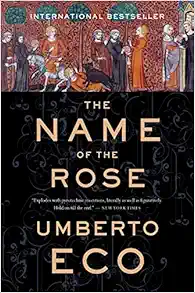
 The Name of the Rose by Umberto Eco is a novel that has to be read twice, and this opinion is from someone who never (hardly) reads a book twice.  This novel is a tome.  There is so much to it.  All the references to historical people and events (What did readers do before google?) and foreign phrases, never mind the obscure terminology.

   The setting is a thirteenth-century monastery.  The protagonist is a Franciscan monk, William of Baskerville, who because of his Franciscan training from the likes of Roger Bacon and William of Occam, is assigned to find out who murdered a monk in this monastery.  Adso is William's scribe, also a Benedictine novice.  It is Adso, who is the narrator of the story.

   Coincidentally, (Is anything ever a coincidence?), this monastery was the chosen venue for a conference between those who supported the pope and those who opposed.  Who was whom and whom was who, is confusing.  (See why the book needs to be read twice.)  I found it interesting that the Dominican, Bernard Gui, was moderating the debate.  William and Bernard were both Inquisitors together, at one time.  What I learned from these particular conversations was that the Franciscans were not in accord as to how "poor" they should be.  The Dominicans weren't mentioned in this particular debate, although today it is assumed that the Franciscans and Dominicans were always mendicant religious orders. The conference was about the heretical teachings of the pope.

   Something else I learned from this story is the invention of spectacles.  William had a pair and taught the glazier monk, who made the stain glass windows, how to make them.  And one had to be careful about new inventions and ideas because you just might be accused of witchcraft.

  There is someone who is accused of witchcraft and Bernard Gui sentences her to be tortured and burned. BTW, I learned that the Inquisitors never tortured, they turned them over to the secular authorities (Think good cop/bad cop.)  This is important!  She wasn't a witch; she was a starving girl who did what she had to do to eat and that included servicing (Use your imagination.) the monks.  In fact, there's a sex scene in "The Name of the Rose," between this unfortunate girl and Adso.  This miserable incident came about because there was another monk murdered and since everyone was on the lookout for suspicious behavior so she was caught.

    The conference ends and the participants take their leave except for William and Adso.  They were given a week to solve the murders and the week is just about up.  The pace picks up here to a climax.  

    Another interesting tidbit I learned was that one of the monks, who was suspected, went to William to confess and William refused him ( William was a priest and as such had the faculties to hear confessions.).  I didn't know a confessor could do that.  They had an argument about it.  William absolutely refused!!  Why?  William refused because he would have been bound by the seal of confession.  A confessor can never tell what he learned in confession.  Here is where I understood why the priests in the monastery weren't very helpful to William and Adso.  They couldn't break the seal of confession.  Evidently, those monks involved in the murders were confessing their sins, hence binding their confessors to the seal of confession.

    Anyway, William figures everything out (including the labyrinth) and the guilty monk is found.  The murderer was a fanatic about books and learning and murdered to save and perpetuate what he thought was necessary.  Can you do evil to promote the good?

    Well, this historic setting is before the Jesuits were founded, so William the Franciscan and Adso the Benedictine are not impressed with the culprit's arguments.  Everything explodes literally and figuratively at the end.  I can't elucidate more or the ending would be spoilt for you.  Trust me, the ending is satisfactory.  


Monday, November 16, 2020

Things Aren't What They Seem

 What a nightmare--falling in love with your enemy.  That's what happens in Julianne MacLean's novel, A Fire Sparkling.  The plot goes deeper.  Vivian even is tortured by the man she thought she loved.  Events were so terrible that Vivian never talked about them.  

The story unfolds when Vivian's granddaughter, Gillian sets out to find out what happened to the people in Vivian's past.  The past is WWII London and Paris.  So this is a historical novel.  


Human Dignity

 It just dawned on me that God created me for Himself.  In Genesis 1: 1-31, we see God made everything for mankind.  I'm in awe to reali...