Search This Blog

Showing posts with label Didache. Show all posts

Saturday, September 26, 2026

Early Christianity

 Up to the third century, educated people wrote Greek.  That includes scripture.  It also seems that Carthage was the center of the church, like we would consider Rome.  Up to the third/fourth century it would not have been Rome.  The Caesars in Rome outlawed Christianity.  Even the famous, Hippolytus, who lived in Rome, wrote in Greek.  

As the peoples across the Mediterranean--Rome, and the Roman empire, became more knowledgeable of Christianity, they wanted the texts in their own language--Latin.  More and more "Bibles" in Latin were written, read, and spread.  There wasn't one, official, book.  Only with Jerome, 400 AD, was a common, Latin text of Scripture published, known as the Vulgate.  Latin was the common language--or the vulgar language.  There was a lot of written works for the 70 people, who were compiling the Bible, to choose.  There were writings from the Apostolic Fathers, such as Barnabas, the Didache, letters from popes and other leaders.  

One of the 70 compilers of our Bible was Epenetus.  He was a companion of Paul in Asia-Minor Romans 16: 5.  His center of comfort, however, was Carthage.  He is known as Epenetus of Carthage and is considered a saint.
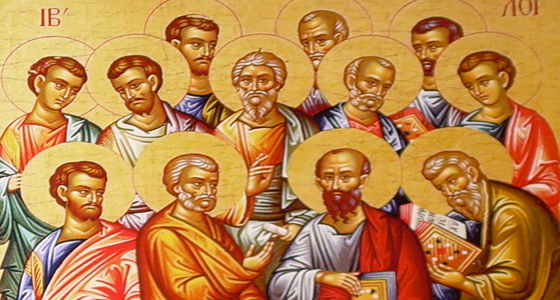
                                            From Greek Orthodox Church of America.

Friday, July 24, 2026

Didache

 The Didache is the oldest book/catechism/constitution, etc. of information, that we have.  It has been dated as around 50 A.D..  It contains the teachings of the twelve apostles.  It was found by the Metropolitan Philotheos Bryennios in a Greek manuscript in Constantinople.  Although, it has been moved to a safer place.  Think of it.  This is older than the Gospel of John and some of the synoptic letters. 

Inside is a manual of instruction for the community on how to prepare catechumen for baptism.  Catechumen is Greek for people taking instructions in the faith.  It also gives the form of the rite to be used and other practical advice.

IOW, it is a manual that outlines teachings, rites, and instructions.  Here are the instructions for the Rite of Reconciliation (Confession).

In the church you shall acknowledge your transgressions, and you shall not come near for your prayer with an evil conscience. This is the way of life. . . . But every Lord’s day gather yourselves together and break bread and give thanksgiving after having confessed your transgressions, that your sacrifice may be pure. – Didache 4, 14 (50 A.D).

Sunday, May 13, 2018

Confession Quote

Sometimes, people ask me when confession started.  I think they are asking because they think it’s something the church started, not Jesus.  I’m sorry to disappoint these critics or church bashers, but it was started by Jesus, Who often forgave people’s sins and passed on this gift to His apostles Matt. 16: 19.  And from the apostles to the bishops and so forth through apostolic succession.  And in early Christianity, confessions were public!  One of the first catechisms of the church is the Didache.  Here is a quote regarding confession.

In the church you shall acknowledge your transgressions, and you shall not come near for your prayer with an evil conscience. This is the way of life. . . . But every Lord’s day gather yourselves together and break bread and give thanksgiving after having confessed your transgressions, that your sacrifice may be pure. – Didache 4, 14 (50 A.D).


Thursday, July 7, 2016

Guests are Like Fish

Today's Gospel was the episode where Jesus sends out his disciples two by two with the instructions, "...look for a worthy person...and stay there until you leave."  Monsignor Moran pointed out this stipulation.

Immediately, I thought of that old Cape Cod saying.  "Guests are like fish, but if you stay longer than three days, they stink."

Anyway, Monsignor asked us how long do you think the disciples would stay.  There were various answers.  Monsignor said that according to the Didache, they stayed no longer than three or four days.  Well!  They are welcome down the Cape, anytime.

But why three or four days?

  •      Jesus was in the tomb three days.
  •      Didn't want to become a burden to their hosts.
  •      It's hard to hit a moving target.
  •      That was all it took to proclaim the Word of God.
  •      They were just planting seeds and if the people weren't receptive, you knew it in a few days.Whatever reason, the disciples certainly were blessed with spiritual gifts because they healed, cured, drove out demons and proclaimed quite successfully.


Human Dignity

 It just dawned on me that God created me for Himself.  In Genesis 1: 1-31, we see God made everything for mankind.  I'm in awe to reali...