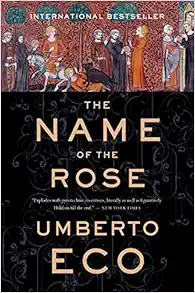
The Name of the Rose by Umberto Eco is a novel that has to be read twice, and this opinion is from someone who never (hardly) reads a book twice. This novel is a tome. There is so much to it. All the references to historical people and events (What did readers do before google?) and foreign phrases, never mind the obscure terminology.
The setting is a thirteenth-century monastery. The protagonist is a Franciscan monk, William of Baskerville, who because of his Franciscan training from the likes of Roger Bacon and William of Occam, is assigned to find out who murdered a monk in this monastery. Adso is William's scribe, also a Benedictine novice. It is Adso, who is the narrator of the story.
Coincidentally, (Is anything ever a coincidence?), this monastery was the chosen venue for a conference between those who supported the pope and those who opposed. Who was whom and whom was who, is confusing. (See why the book needs to be read twice.) I found it interesting that the Dominican, Bernard Gui, was moderating the debate. William and Bernard were both Inquisitors together, at one time. What I learned from these particular conversations was that the Franciscans were not in accord as to how "poor" they should be. The Dominicans weren't mentioned in this particular debate, although today it is assumed that the Franciscans and Dominicans were always mendicant religious orders. The conference was about the heretical teachings of the pope.
Something else I learned from this story is the invention of spectacles. William had a pair and taught the glazier monk, who made the stain glass windows, how to make them. And one had to be careful about new inventions and ideas because you just might be accused of witchcraft.
There is someone who is accused of witchcraft and Bernard Gui sentences her to be tortured and burned. BTW, I learned that the Inquisitors never tortured, they turned them over to the secular authorities (Think good cop/bad cop.) This is important! She wasn't a witch; she was a starving girl who did what she had to do to eat and that included servicing (Use your imagination.) the monks. In fact, there's a sex scene in "The Name of the Rose," between this unfortunate girl and Adso. This miserable incident came about because there was another monk murdered and since everyone was on the lookout for suspicious behavior so she was caught.
The conference ends and the participants take their leave except for William and Adso. They were given a week to solve the murders and the week is just about up. The pace picks up here to a climax.
Another interesting tidbit I learned was that one of the monks, who was suspected, went to William to confess and William refused him ( William was a priest and as such had the faculties to hear confessions.). I didn't know a confessor could do that. They had an argument about it. William absolutely refused!! Why? William refused because he would have been bound by the seal of confession. A confessor can never tell what he learned in confession. Here is where I understood why the priests in the monastery weren't very helpful to William and Adso. They couldn't break the seal of confession. Evidently, those monks involved in the murders were confessing their sins, hence binding their confessors to the seal of confession.
Anyway, William figures everything out (including the labyrinth) and the guilty monk is found. The murderer was a fanatic about books and learning and murdered to save and perpetuate what he thought was necessary. Can you do evil to promote the good?
Well, this historic setting is before the Jesuits were founded, so William the Franciscan and Adso the Benedictine are not impressed with the culprit's arguments. Everything explodes literally and figuratively at the end. I can't elucidate more or the ending would be spoilt for you. Trust me, the ending is satisfactory.