Search This Blog

Showing posts with label Religion. Show all posts

Tuesday, August 18, 2026

Early Religion

 
Philosophy was the noun early Christians used when referring to religion. They called it philosophy, after the philosopher, Philo,  who lived in Alexandria.  He wrote about politics and religion.  He maintained that the first Bible, the Septuagint and Jewish law were a blueprint for current theory.  He harmonized the Torah with Greek philosophy.  His allegorical exegesis was important to the Church Fathers.

That's what the Church Fathers called theology, and religion.  Here is an Imaginative illustration of Philo made in 1584 by the French portrait artist André Thevet


By André Thévet - André Thevet (1502-1509): Les vrais pourtraits et vies des hommes illustres grecz, latins et payens (1584)https://archive.org/details/lesvraispourtrai01thev, Public Domain, https://commons.wikimedia.org/w/index.php?curid=12233681


Tuesday, March 10, 2026

Of and/or From

 It drives me crazy that many think that the First Amendment says "Freedom from religion."  No it's "Freedom of religion."

Think about it.

Why would our Founding Fathers say "Freedom from religion", when the reason they came to America in the first place was to be free to practice their religion?  The Amendment says the government will protect you so you can practice your religion, not keep religion away from you.  

                                  Religion in the Colonies Map Worksheet by Ace Up Your Sleeve | TPT

Saturday, May 24, 2025

The Rock that Changed Everything

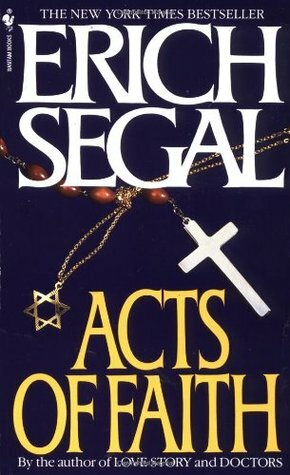
 For over ten years, (not hyperbole) I've seen this book, on the top shelf.  I always passed it by, barely dusting it.  Acts of Faith, the title, is quite bold.  That's what made me pass it by.  The noun, "Faith", blaring so bright.

I thought it was a theology book.  It was probably a religious textbook.  I ignored it.

Until the day I decided to weed my books.  Acts of Faith was written by Erich Segal. Erich Segal wrote Love Story.  That Erich Segal!!!  Acts of Faith is a novel!

All these years have gone by, and I could have enjoyed a good Erich Segal story.  This particular story intertwines the lives of 3 people who grew up in New York.  The reader gets involved and even though he kind of highly suspects the way the story is going, he rapidly turns each page.  Danny and Deborah are brother and sister.  Their father is a famous Jewish Orthodox rabbi.  Danny is the heir apparent.  Deborah is to be married when she turns 18.  Both buck the system.

Tim Hogan is an orphan.  He is brought up by relatives who never read Dr. Spock.  Tim had it rough.  In fact, he was a bully, even beating up Danny. However, the day he threw a rock through the rabbi's window changed everything. To pay for the damage, Danny becomes the Shabbat Goy.  He lights the lamps for Shabbat.  Doing that job, Danny learns Yiddish, and more importantly, meets Deborah.

Since he is Catholic, and she is Jewish, there is no way they can be a couple.  They move on.  More or less.  Sometimes more.  More often less.  He becomes a priest.  Deborah moves to Israel and when she's 18, she moves to a kibbutz.  

Meanwhile, Danny tries to survive the pressure to take over the family ministry.  He and Tim become good friends, but their lives take them on different journeys.  

How these three become involved, and grow together, is the story.  Besides the passion, religious politics, and religion, the reader actually learns about the Jewish and Catholic faiths.  In fact, I finally understand why Catholic priests can't marry.  (I'm sure Erich Segal intended to prove the opposite.) Tim Hogan advances to become a bishop in Brazil.  Segal in describing the ceremonial rite states, "Such was the silence in the massive basilica that His Holiness could be heard to whisper, "L'anello." He then said quietly in Latin. "Your hand." Tim complied and stretched forth his wedding finger as the Holy Father pronounced in solemn tones, "Take this ring, the seal of your fidelity. With faith and love protect the bride of God, His holy Church."

This exchange dope slapped me.  Don't we say the same vows in our marriage ceremonies?  The words spoken during the ring exchange are very significant.  They express love, fidelity, and commitment.  

Take this ring as a symbol of my love and commitment to you, and as a reminder that I will always be by your side, no matter what life brings.”

I give you this ring as a symbol of my love and devotion to you. I promise to stand by your side, to support and encourage you, and to cherish you for all the days of my life.”

WOWZA! The priest is marrying the church.  The church is the bride; hence, her partner must be male.  The church has always been called the bride of Christ.  The priest marries the church and vows to "love and protect the bride of God, His holy Church."

How do you like that?  I learned.  I understand.  Finally.  Oh, and it was a good story, too.  


Friday, April 5, 2024

Candles

 In March, the family celebrated by husband's 80th birthday.  That's a lot of candles to put on a cake.  Where did this tradition come from--adding a candle for each year to celebrate a birthday?

History points to the ancient Greeks.  Tradition tells us that candles were used to honor the goddess Artemis, the goddess of the moon.  The flame on a candle is like the light the moon gives.  The smoke dispersed in the air was pictured as offerings to the moon goddess.

It's such a nice image.  Even candles are still used today.  Candles add a nice touch.  On birthdays, it makes the birthday person special.  They get their very own cake; just to celebrate their life.  

Adding candles makes a dinner romantic.  Put some easy, soft music on, and the evening is amorous.

Candles in religion are important.  They exemplify light.  All religions I know of, use them. In ancient Egyptian times, candles were used to honor gods.  Buddhism uses candles during meditation.  Since Judaism uses candles to memorialize people and events, Christianity continued the practice. 

Light from a candle is a metaphor of life and light, which is perfect to mark birthdays, and religious ritual.  In the final analysis, candles used for birthdays, romantic evenings, and of course religious rituals, enrich the celebration. They're metaphors, expressing love, hope and love.


Saturday, March 26, 2022

Jesus is NOT an Abstraction

 Jesus often criticized authority, but He never preached overthrowing it.  I think He accepted authority but never thought authority was perfect.  He had opinions and often said out loud what He thought should be corrected.  For certain, Jesus didn't like the hypocritical legalism of the Pharisees.  But He didn't plot to overthrow or undermine them.  He was a loyal, law-abiding, Jew. 

You have to remember that Jesus is in an institutional religion.  He would obey the commandments, beatitudes, spiritual and corporal works of mercy and expects us to try and follow the church's teachings, too.  Remember Jesus didn't come to abolish religion, He came to fulfill it.  Following religion is following Jesus. He is not just a feel-good spiritual warmth. He is real.


Monday, September 26, 2016

The Difference Between Faith And Religion

Faith is what you believe.  Everyone has it, even if one says, "I don't believe in anything," has just stated his belief.

Religion is the systematic organization of thoughts regarding a divinity, prayer, and practices.

They are not the same.  One can have faith and religion but another can have faith and no religion.  Today there are more people that have faith and no religion.  There are different reasons offered.  Laziness and sin are up pretty high on the list.  But it isn't our job to judge; we're not God.  Only He knows what we've been through that makes us who we are. 

Friday, January 29, 2016

What is the Meaning of Life?


Tom Lyman was on Boston Catholic TV, this morning.  He was talking about the New Evangelization.  Tom stressed the need to be ready to share our faith, when the opportunity presents itself.  He gave as an example an encounter with a customer in the checkout line.  He was a stranger but while waiting, the two of them shared a sigh of resignation.  (It looked like a long wait.)  The man said to Tom, "What is the meaning of life?"

Tom said he used the opportunity to share the kerygma.  I understand that Tom shared the Gospel message.  But he didn't say exactly what he told the man.

So all day, I've pondered that question (just in case I'm ever asked, "What is the meaning of life?").

The first thing I'd do is affirm the question and questioner.  This question has been asked by everybody, throughout history, at some point in their lives.  Next, I'd tell him about my experiences volunteering in prison.  Now, if anybody had a good reason to ask, "What is the meaning of life?", it would be someone serving a life sentence behind bars.  Yet, the population I deal with, see a meaning to life.

Some of them have had money, beautiful families, beautiful homes, flashy cars, big boats, great jobs, professions, and even owned businesses.  All of it is gone.  Hence, they have experienced that these things weren't enough.  You would think that having a purpose in life, would give it meaning.  It didn't satisfy.  You always want more.  The more money you have, the more you spend.

What they have found is religion.  Don't scoff.  It's the one thing that has given meaning to their lives.  It teaches that you have a purpose.  Religion offers community and that means support.  Religion teaches you to love and serve others.  You love God and He wants you to love and serve others.

In fact, religion may be a factor, in not only happiness and well-being, but health also.  Is that meaningful enough for you?  There are three locations where people live the longest: Okinawa, Japan, Sardinia, Italy, and Loma Linda, California.  What do they all have in common?  They have religion, yes, but each place has a different religion.  But each religion stresses community--love one another, love God, serve each other.

Okinawa is an island.  Most of the residents are Buddhists.  However, the residents all practice a custom called moais - love one another and serve each other.  Sounds like the Christian Golden Rule doesn't it?  Sardinians are Catholic and love God and He wants us to serve one another.  The people in Loma Linda are Seventh-Day Adventist and practice the Golden Rule.

Hence, I assert that the meaning of life is to find God.  Religion is the path to Him.  And if you don't believe me, I know as a fact, someday you will.  Try religion, what have you got to lose?

Monday, October 15, 2012

The Gospel According to our Leaders

I'm reading American Gospel, God, the Founding Fathers, and the Making of a Nation, by Jon Meacham.  It's very interesting.  I find it particularly enlightening in regards to the fact that it's really Divine Providence who's in charge.  During World War II, there was a special closeness to God.

The ceremony for the signing of the Atlantic Charter is a good example.  A reading from Joshua was given, "Be strong and of a good courage; be not afraid...for the Lord thy God is with thee whithersoever thou goest."  Meacham says that Churchill wept.  Three hymns were sung by a mix of American and British sailors: "Onward Christian Soldiers, Eternal Father, Strong to Save and the beginning of Psalm 90."

O God, our help in ages past,
Our hope for years to come,
Be Thou our guide while troubles last,
And our eternal home.

The author, continues to conjecture that Americans were wary of this strongly Anglican service.  What if you're not Christian?  Americans prefer an ecumenical service (ministers of different faiths) but the theme of the ceremony was universally accepted: liberty, justice, and democracy.

Franklin played the part of a national pastor.  I think he looks the part.  Can't you picture him as a rabbi, minister, or priest?  On D-Day, June 6, 1944, the President led the country in prayer.  He asked that our military operation against the Nazis be blessed with success.

What I've just quoted is a good example of the book.  The theme is that religion shapes politics.  And at this particular time before the election, the book is comforting.  It's "good news" that religion shapes politics, yet doesn't control it.  Right from America's founding, our nation has struggled with faith and government.  It proves that God is in charge.  

Wednesday, September 14, 2011

Do Catholics Pray to Saints?

The Argonauta Book Club meeting went well.  The Argonauts didn't eat very much, but that just means that the people at Work will.  (I'll bring the left-overs to work today.)  I was telling everyone about my plans to go to the beatification of Pere Marie Jean Joseph Lataste, O.P.  This was an opportunity to explain the process of sainthood.  But more than that, it brought up the subject of religion.

Three of the Argonauts are married to Catholics.  One said that her Catholic husband always attended the Episcopal Church's Mass with her.  But he said that's as low as he will go.  (There was an "o-o-oh, tsk, tsk.) Another said that her husband attends his Catholic Mass once in awhile, and he never goes to her Universalist church.  The last Argonaut lady said that her husband always attends Sunday Catholic Mass but he won't go with her to her church.  (I didn't choose to enter into the fray.)

But my Episcopal friend in discussing "how low" her husband's standards had fallen was explaining that there were very few differences between Catholics and Episcopalians.  One diff was that Episcopals don't pray to saints (since I had been talking about the beatification of Fr. Lataste.)

"Oh...oh, do Catholics pray to saints, I was asked."

I explained it's not the same as when we pray to God.  I said that Catholics think of saints as friends just as I was talking to my Argonaut friends,  Catholics may talk (which is a definition of prayer) to saints.  After all, we believe that death is the beginning of a new life.  So we're not praying to dead people, but to people alive with Christ.  Our friendships don't end in death; I'll consider the Argonauts my friends in heaven.  And I'll be talking with them then, too.

Saturday, June 25, 2011

My Prayer for Young People


This post is what I sent in response to  Meghan Wenger's request for stories.  (See my post on June 14, 2011.) She is going to be a junior at Boston College.  She is working on a book project and looking for examples and reasons for young people to be Catholic.  It's not too late for you to help her out, also.  She'd like your story by July 1st, 2011.  Send it to catholicinspires@gmail.com   

      I was in front of the altar pronouncing my wedding vows, and privately promising God that I would use this vocation of marriage as a means to save my soul, and take my husband, and any future children, along with me.  This Catholic ceremony was very important to me.  I wanted the sacramental grace that only the Catholic Church can give.  Sure I can get married by the Town Clerk and have a piece of paper that says I’m married legally.  Sure I can stand in front of a justice of the peace, and my husband and I can make personal commitments to God.  And sure, we could have just lived together and made a commitment between ourselves.  But I wanted more.  I wanted the best.  I wanted what only the Catholic Church can offer – sacramental grace.  To Catholics, marriage is a sacrament!  It is that important. 
            All the milestones in my life are marked with special religious signs: birth (Baptism), childhood (First Communion and First Penance), Teen years (Confirmation), choice of vocation (Marriage, Priesthood), and death (Sacrament of the Sick, formerly known as Last Rites).   I love them all.  I love the Traditions, the Communion of Saints, Mary, and most of all, the Eucharist.  Being Catholic is part of my identity.  It’s how I view the world. 
            Let’s take one modern issue.  Today’s culture tells us that people thinking of marriage should cohabitate to see if they’re compatible.  Today’s culture is also telling us that homosexuals should be able to get married.  Today’s culture also encourages divorce if things don’t work out.  Can’t you see how this perception is weakening families?  The modern cultural perception of marriage is just plain wrong. 
The Church has always encouraged strong family life.  Its voice can be heard opposing anything threatening the traditional definition of marriage.  Strong families are something that not only the church needs, but also society.  Our present culture of easy divorce, cohabitation, and same sex marriage is redefining the family.  It is undermining the traditional family.  The Church teaches us to uphold the family.  I agree.  To tell you the truth, I think this present idea of co-habitation is nothing more than free maid service with sex.  I see no advantage for a girl doing this.  The guy gets free sex, maybe even some rent money, and probably someone who’ll cook and do laundry. 
             Catholic family life does not only include the biological family.  Being Catholic means you are part of a larger community.  This is most powerfully symbolized in the Eucharist—the central sacrament of our faith.  Understanding the Eucharist, one learns that we are never alone.  God is with us in Holy Communion.  When we receive the Blessed Sacrament, we are one with God.  We can open ourselves to God’s presence in Eucharistic Adoration, prayers, scriptures, and the reception of sacraments.  Catholics are not alone.  That is why we are concerned about others.  Just as we are one in communion with God, we are also in communion with one another.  We care about the salvation of others’ souls.  Not only do Catholics give to the needy, but we care enough about others to try and stop them from killing themselves, their babies, and others.  Yes, we believe in life.  Life is a gift from God, which is why I love celebrating the different stages of life through our Catholic sacraments.
            Since we have this view of one large Catholic family, Catholics are taught to see and pray for global concerns.  We have a universal vision; yet, Catholicism teaches that each individual is important.  Catholics have a long history, beautiful basilicas, schools, and hospitals, besides its wonderful liturgy and music.  Identifying with the Catholic Church gives everyone a connectedness; they are members of the one true Church founded by Jesus Christ.  Everyone is seen as having an inherent dignity.  Each of us was created by God, and should be treated as such.  
             I’ve found that my Catholic faith has given me the answers to all my real-life questions. Today, however, young people have unique challenges.  When I grew up, I was surrounded by a Catholic culture.  I went to a Catholic school.  Just about all my friends were Catholic, and those that weren’t didn’t think  any differently than I did because they were from religious families that upheld the same Ten Commandments that I was taught.  Television portrayed ideal families that were models for everyone to live up to.  There were even commercials on TV that touted, “The family that prayed together, stayed together.”  My parents didn’t have to be vigilant to raise me with Catholic values, because we were surrounded with them in school, play, and culture.
              Today, the world is the opposite.  Our good Catholic values are mocked.  Traditional families and their values are denigrated.  Even computer games portray unacceptable aggression as fun, exciting, and well—normal.  The words to some songs that I hear are below the minimal standards of decency.  It seems like anything goes.
             One way for our young people to confront this contemptible culture is to be grounded in faith.  If someone is confident in their knowledge, “if they know where they are coming from,” then not only will they not be swayed by all the “bling” of the modern world, but also be able to confront it.  Pope Benedict XVI, in the foreword to the new catechism for young people, YOUCAT, says
So I beg you: Study this Catechism with passion and perseverance.  Make a                                                        sacrifice of your time for it!  Study it in the quiet of your room; study it with a                                                   friend; form study groups and networks; share with each other on the                                                                                           Internet.                                                                                                                                                                      …You need to know what you believe.  You need to know your faith with                                                                            that same precision with which an IT specialist knows the inner workings                                                                                         of a computer.  You need to understand it like a good musician knows the                                                                                   piece he is playing.  Yes, you need to be more deeply rooted in the faith than                                                                             the generation of your parents so that you can engage the challenges and                                                                                                     temptations of this time with strength and determination.
           Times have changed.  The world and its culture does not support Catholic families.  You have to work at being and staying Catholic, but it’s worth it.  Young people need to study their faith: the catechism, scriptures, Bible commentaries, papal encyclicals, Church history, and writings of the Church Fathers.  They need to be active in their parishes. 
           My faith has enabled me to make sense of the world.   I have always felt supported by my religion, i.e., spiritually, and emotionally and physically in my parish community.   Knowing that I am connected to a universal Church, with people praying for me and my needs has always been a comfort, and a source of strength.  Being Catholic for me is a concrete experience, not just an idea.  To see my children carrying on the Church customs and traditions is a source of comfort for me, because I know they’ll be all right.  Their needs will be met the best they can be.  All they have to do is to remain faithful.   This is my prayer for my family and all young people.

Rabbi

 Did you ever wonder why a simple carpenter was called Rabbi?  A rabbi is a teacher, a master in spiritual things.  And it wasn't just H...