Search This Blog

Showing posts with label Slavery. Show all posts

Wednesday, August 27, 2025

Trouble on the Plantation

 The Kitchen House by Kathleen Grissom is a book club recommendation.  This book will appeal to those who love historical fiction, family relationships, and tense drama.  It can be a page turner.  The setting is the South around 1800.  Lavinia's family was on route to America from Ireland. Her parents die and Lavinia and her brother are indentured to different people to pay for the family's passage.  She lives with the ship's captain's family on a typical southern plantation.

Eventually, she fits in place, although not part of the owner's family.  She is more part of the slave's family.  She works in the kitchen and grows close to her enslaved family and they love her back.

The reader will see how the slaves were treated and the conditions they tried to overcome.  The owner's family also had troubles.  The father was too often away.  The mother was ill.  The daughter accidently dies.  The son is mistreated by his tutor.

When the plantation owner dies, the mother is put in an insane asylum and Lavinia is sent to live with the mother's relatives.  Here she thrives until she is married to Marshal, the son of the plantation owner.

Life is ironic, here.  Lavinia returns as the mistress of the plantation.  Her marriage, however, is not happy, to say the least. Marshal is abusive and a drunk. Lavinia identifies more with her enslaved family than with Marshal.

Upheaval comes.  Tragedy strikes.  Lavinia is fine but things will never be the same.


Thursday, March 27, 2025

Free Will

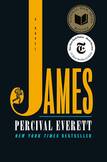
 I enjoyed the last book I read by Percival Everett, so much, that I just finished reading (in two days), James.  The book Huckleberry Finn by Mark Twain has just been reinvented by Everett.  James is the main character, who is Jim, from Huckleberry Finn.  The story is what could have happened if Jim escaped and his adventures, with Huck.

The history, emotional turnstile, and dialogue, kept me turning pages.  We hear Jim expound on his views of slavery and religion.  Jim is a well-read slave.  He can also write and does start to write his autobiography.  Jim pontificates about the morality and unfairness of slavery.  His religion is simple, or rather, not existence.  Thomas Aquinas would "answer that," God is not deus machina.  Man has free will and is free to choose evil.  Jim believes that if there were a God, there would be no slavery.

The two adventurers have little time to philosophize.  They get captured, blown up, sold again, Jim becomes a blacksmith, a tenor singer, and other assorted misadventures.  They also learn that the Civil War has started over slavery.  

Jim heads back South to his family.  Huck goes home, also and helps Jim locate his wife and daughter, who were sold.  Jim does find and helps them escape to the north.  Finally, free Jim becomes James.


Wednesday, February 2, 2011

Married Saints Too

Last time I talked about St. Anna-Maria and Domenico Taigi.  In this post I'd like to write about Venerable Pierre and Juliette Toussaint.

Pierre Toussaint is the patron saint of hairdressers because that was his occupation.  I wonder if he's the patron of women with alopecia.  He should be because at the time Pierre was hairdressing, men and women wore wigs.  He dressed their hair.

He actually was born a slave in Haiti.  He was lucky to have a good man as a master, who not only taught Pierre how to read and write but also his catechism.  Pierre grew in the Catholic Faith, as his master instructed him.  When the family moved to New York, the household went too; that included Pierre.

Pierre's master, Jean Berard apprenticed him to a hairdresser and that's where Pierre learned the trade.  Pierre was a natural, both because of his personality and also he had a talent.  It seemed he had an eye for what worked where, whether it was hair, dress, or a room in a house.  He became known and was popular.  When the master, Berard died, Pierre took care of his widow until she died.  Upon Mrs. Berard's death, Pierre was freed from slavery.

As a free man, and working for himself, he became wealthy.  He did work hard and had a substantial clientele, and he made enough money to be not only generous to others, but also to invest money in several ventures.  Eventually, Pierre married Noel Gaston.  She was only 15 and a slave, so he bought her.  Then he freed her and asked her to marry him.  She was perfect for Pierre.  They believed and thought alike.  The two of them were devoted Catholics.

Between the two of them, they helped many.  They turned their home into a shelter for orphans, a credit bureau, an employment agency, and a hostel for the poor.  Pierre even contributed to the construction of Old Saint Patrick's Cathedral in New York City.

They never had any children themselves, but they did adopt his niece when her mother, Pierre's sister, died.  They loved and cared for this child as their own and  were heartbroken when she died at 14.

Pierre was to outlive his beloved wife.  Noel died a couple of years before Pierre in 1851.  He died in 1853.  It was edifying to read of this successful, and holy, black man in this time period of history.  That he could make it, was certainly a testimony to the grace of God.

h/t Fr. Thomas Kevin Kraft, OP

Rabbi

 Did you ever wonder why a simple carpenter was called Rabbi?  A rabbi is a teacher, a master in spiritual things.  And it wasn't just H...