Thomas is the disciple who didn't believe Jesus rose from the dead, unless he could put his fingers in Jesus' wounds. Thomas is called Didymus because Didymus means twin. He was a twin. Do you know who Didymus' twin was? It's another disciple.
It's you and me. We are the ones who doubts, now and then. It's part of being human so we can all identify with Thomas.Search This Blog
Showing posts with label Doubting Thomas. Show all posts
Sunday, May 1, 2022
Friday, April 17, 2020
Everyone Identifies with Thomas at One Time or Another
Third Sunday of Easter Year A
Lectio:
John 20: 19-31
On the evening of that first day of the week, when the doors were locked, where the disciples were, for fear of the Jews, Jesus came and stood in their midst and said to them, "Peace be with you." When he had said this, he showed them his hands and his side. The disciples rejoiced when they saw the Lord. Jesus said to them again, "Peace be with you. As the Father has sent me, so I send you." And when he had said this, he breathed on them and said to them, "Receive the Holy Spirit. Whose sins you forgive are forgiven them, and whose sins you retain are retained."
Thomas, called Didymus, one of the Twelve, was not with them when Jesus came. So the other disciples said to him, "We have seen the Lord." But he said to them, "Unless I see the mark of the nailmarks and put my hand into his side, I will not believe."
Now a week later his disciples were again inside and Thomas was with them. Jesus came, although the doors were locked, and stood in their midst and said, "Peace be with you." Then he said to Thomas, "Put your finger here and see my hands, and do not be unbelieving, but believe." Thomas answered and said to him, "My Lord and my God!" Jesus said to him, "Have you come to believe because you have seen me? Blessed are those who have not seen and have believed."
Now, Jesus did many other signs in the presence of the disciples that are not written in this book. But these are written that you may come to believe that Jesus is the Christ, the Son of God, and that through this belief you may have life in his name.
Studium:
I noticed that the apostles are locked behind closed doors because they fear the Jews. They are not out and about spreading the news of the Resurrection. Pentecost is coming and then they will be given the tools to go out and evangelize. When Jesus suddenly appears in this room, I can imagine the shock. Jesus greets them with a traditional greeting, "Peace be with you." Any fear the apostles have is relaxed. They are joyous.
And again Jesus talks about His Father sending Him and the Holy Spirit forgiving sins. Do they understand? Well, they are used to Jesus' cryptic speeches. Just wait for Pentecost, when all will be understood.
However, the apostle, Thomas wasn't there. He missed out. When his confreres babble on about seeing Jesus, he thinks they're kidding. Where's the punch line?
Hold on Thomas, it's coming and the joke's on you.
Again Jesus appears in the room. C'mon Thomas. Put your money where your mouth is--put your finger right in His wounds. There's no need; it's obvious. Thomas proclaims "My Lord and my God!"
Who hasn't been a doubting Thomas? This scene has been a beacon of hope to all of us at one time or another. When we doubt, when we don't understand and can't believe, we think of Thomas and pray, "My Lord and my God."
And what a nice conclusion to this story is Jesus' blessing all we Christians with "Blessed are those who have not seen and have believed."
Meditatio:
I remember not believing in the True Presence in the Eucharist. I still received communion and prayed "My Lord and my God." Thanks be to God, the gift of faith was given to me. I believe.
Oratio:
Lord, I believe. Help any unbelief.
Contemplatio:
My Lord and my God.
Resolutio:
I resolve to thank the Father and the Holy Spirit for their Son, in every Eucharist I receive.
Wednesday, November 19, 2014
Statues
One of the catechumenates in RCIA makes me laugh. He absolutely no knowledge of religion whatsoever. He was scared of the priest at his first Mass. Now, he looking at statues and wants to know how we know who is who.
One of the statues is this one. He wondered what they were looking at? The fancy stitching? A spot of dirt? A bug?
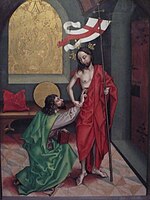
This is a statue of doubting Thomas. The apostle Thomas doubted that Jesus had risen. Thomas didn't believe the reports of others. So when Jesus met Thomas, He told him to put his finger in His side. This is the scene that's depicted.
Wednesday, July 3, 2013
Our God of Reversals
![]() |
| Carravaggio's Doubting Thomas |
No wonder Thomas said "No thanks." Just seeing is believing. Thomas is so very much like us.
Think of the lesson of the story of doubting Thomas. Because of Thomas' doubt, Jesus says, "Blessed are those who have not seen and have believed." That's us!!! \0/ \0/ \0/
Another lesson is the fact that Jesus shamed Thomas, and because of Thomas "epiphany", Thomas' faith is solidified. His faith grows exponentially. Thomas goes on to be a missionary to the East. India's Christians venerate him. I vaguely remember that there are a few Christians in Tibet (yes) and they trace their history to St. Thomas, too. (I'm too lazy to do a google search and prove this to you.)
Another interesting story revolves around Thomas being the only apostle not being present to see the resurrected Jesus, and the death of Mary. Thomas was the only witness to see Mary assumed into heaven (making up for his being left out of seeing the resurrected Jesus). The other apostles were miraculously transported to Mary's death bed and were present with her. Thomas missed out, again. However, Thomas was later transported to her tomb, where he saw her assumption, into heaven. As Mary ascended, she dropped her girdle (belt) to Thomas.
Here's the big reversal. (God does this continually.) Thomas now tells the other apostles that Mary was assumed up to heaven. They doubt. Not until the apostles see Mary's empty tomb and her very own girdle (belt), do they believe. (Come on guys, put your hands inside the tomb, and finger this girdle. Blessed are those who have not seen and have believed.)
The story continues. Thomas' receiving of Mary's girdle, is often depicted in art. Thomas' doubting is reduced to a metaphorical knot in the Bavarian painting, Mary Undoer of Knots.* For some reason, this famous painting by the German, Johann Georg Melchior Schmidtner (1700) became the poster for the devotion, Mary Undoer of Knots. Many Catholics venerate this image. One famous pilgrim was so taken by the image that he brought it to his own country. I'm talking about Jorge Bergoglio who later became Pope Francis I,. Archbishop Bergoglio promoted her veneration in Latin America. The devotion attracts people with small problems. Archbishop Bergoglio had the image engraved on a chalice he presented to Pope Benedict XVI. And a similar chalice was presented to Bergoglio, when he became pope, by the Argentine people.
Here's the thread: doubting Thomas, doubting apostles, all tied up in Mary's girdle (belt). God can do anything. Undoing knots is easy, especially when compared to changing doubters into believers.
Virgin Mary, Mother of fair love, Mother who never refuses to come to the aid of a child in need, Mother whose hands never cease to serve your beloved children because they are moved by the divine love and immense mercy that exists in your heart, cast your compassionate eyes upon me and see the snarl of knots that exist in my life.
You know very well how desperate I am, my pain and how I am bound by these knots.
Mary, Mother to whom God entrusted the undoing of the knots in the lives of his children, I entrust into your hands the ribbon of my life.
No one, not even the Evil One himself, can take it away from your precious care. In your hands there is no knot that cannot be undone.
Powerful Mother, by your grace and intercessory power with Your Son and My Liberator, Jesus, take into your hands today this knot...I beg you to undo it for the glory of God, once for all, You are my hope.
O my Lady, you are the only consolation God gives me, the fortification of my feeble strength, the enrichment of my destitution and with Christ the freedom from my chains.
Hear my plea.
Keep me, guide me, protect me, o safe refuge!
Mary, Undoer of Knots, pray for me
![]() |
| St. Thomas Cross |
* The concept of Mary untying knots is derived from a work by St. Irenaeus of Lyons, Adversus haereses (Against Heresies). In Book III, Chapter 22, he presents a parallel between Eve and Mary, describing how "the knot of Eve's disobedience was loosed by the obedience of Mary. For what the virgin Eve had bound fast through unbelief, this did the virgin Mary set free through faith.
h/t https://en.wikipedia.org/wiki/Thomas_the_Apostle
Subscribe to:
Posts (Atom)
Human Dignity
It just dawned on me that God created me for Himself. In Genesis 1: 1-31, we see God made everything for mankind. I'm in awe to reali...
-
St Dominic and the Devil by Pietro della Vecchia D Don't you just love legends? I mean stories. St. Dominic stories abound. Of cou...
-
Yesterday, I posted about a sculpture on the top of a column in the church of St. Mary Magdalen , in Vezelay, France . Meditating upon the...
-
My Lay Dominican Chapter, Our Lady of Mercy, has the best spiritual director. Today he gave us, what my "cloistered brothers" ca...

.jpg)


