
Showing posts with label Sacrament of Penance. Show all posts
Showing posts with label Sacrament of Penance. Show all posts
Sunday, May 13, 2018
Confession Quote


Friday, February 12, 2016
Public to Private Confession

Tonight's Reading in the Evening Prayer for the Friday after Ash Wednesday is from James 5:15-16.
Declare your sins to one another, and pray for one another, that you may find healing, reminded me of the teaching my formation team and I gave last weekend, on the Sacrament of Reconciliation.
James is talking about the early church, when they had public confession. At first, the people just confessed to one other, i.e., "I'm sorry I used your tools without your permission; I'm sorry I lied to you..."
However, a big sin, like apostasy, was a mortal offense against the entire church community. Remember Christianity was against the law. One who sinned against the entire community by denying Christ, or snitching where the place their Mass was being held, needed to apologize to the community. The community would then assign the penitent, a penance. Once the penance was completed, the bishop was called in to give absolution.
Note that this sequence is opposite of our current Sacrament of Reconciliation. Then it was to do the penance first, then you get absolution.
Theology grows in understanding, just as we human beings do. We once thought the world was flat. Now we know different. So also, theology and the church grows. During the Middle Ages, Christians felt they needed more in confession and often asked the clergy and local religious for spiritual direction to become better people. The Celtic monks were known for this. The Irish missionary monks and nuns guided people spiritually and developed an examination of conscience in reconciling them to God. Eventually, bishops saw the value of this type of spiritual reconciliation.
BTW, it was in the sixteenth century that St. Charles Borromeo invented the confessional box. He saw the need for privacy. Also, the Council of Trent defined a rite for Confession. Also, the seal of confession was enforced. Secrecy was promised.
The Second Vatican Council renewed the Sacrament of Confession. It is preferred to call the sacrament, the Sacrament of Reconciliation. Reconciliation is stressed, not penance. Penances are not physical works, anymore. The sacrament asks the penitent to change his life. Everyone needs to orient themselves towards God. The confessor assigns a token penance and gives absolution. THEN the penitent goes away on his own and performs his penance. It's absolution before the penance.
This reading is a reminder of the love and mercy Jesus is always giving. He wants us to get as close to Him as possible. Draw near to God, and He will draw near to you...Humble yourselves in the sight of the Lord, and He will exalt you. James 4; 8-10
Monday, February 8, 2016
Dirty Little Secrets

The dirty little secrets are not what the sacrament is about. The sacrament is a reconciliation with God. Sin separates us from God and Confession/Reconciliation/Penance (different names for the same sacrament) bring (reconcile) us back to God. This is why the confessors say, "It's humbling, liberating, a great grace."
The confessor sees how the penitent is sincerely trying to live a moral life. They don't like what they've done, or how they are, and want to start over. The confessor sees the desire to be a better person, to get closer to God, to be what God them to be. The confessor is humbled to be an instrument that God uses to be the means to speak in persona Christi. The confessor sees how much people love their spouses, and children, and parents, and others. These people truly are God's children and want to live that way. They want their relationship with God to be better and that's why they're there--in confession. No wonder priests call it humbling and a great grace.
And we Catholics are blessed to be the recipients of that grace. We Catholics get to experience God's mercy. Yes, the Sacrament of Reconciliation is the way to get closer to God. Receiving the Eucharist is as personal a relationship anyone can get; we become One with God. And the Sacrament of Reconciliation is the means to the Eucharist.
This topic was inspired by my reading of a 3-month-old newspaper article. "Confession is about the mind-boggling mercy of God," by Fr. Dennis Baker, in the National Catholic Reporter, November 20-December 3, 2015, Vol. 52, No. 3, columns 23.
Saturday, February 6, 2016
Paul Miki and Companions
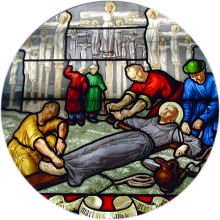
Today, I'm teaching parents whose children are receiving the Sacrament of Reconciliation for the first time. I'm giving the parents the history of the sacrament.
This morning, I opened my prayer book to find out that today is the feast of Paul Miki and Companions. I can use this feast in explaining the history of the Sacrament of Reconciliation. In early Christianity, the sacrament was public because Christianity was just beginning to develop. Christianity was outlawed. When it was discovered that you were Christian you were arrested, beaten, tortured, and killed in various horrendous ways. Many denied that they were Christians. That's apostasy.
Afterwards, these traitors tried to go to church. What nerve, huh? Of course, their brothers and sisters could see that they needed to be accepted back, so the deniers of Christ had to apologize to the community. This is how the first confessions were done--publically. The community decided on the penance. Once the penance was fulfilled, the bishop came to give absolution.
I am afraid that I'd be a coward and deny Jesus. I'd need the grace of God to not be afraid and be strong enough to declare that I am a child of Christ.
Then this morning, I read about Paul Miki and twenty-five companions who were martyred in Japan. Not only were they not afraid, they were happy about it. They rejoiced. They sang Te Deum!
May God bless them! They rejoiced because they were dying for God. They were hung on crosses, much like Jesus. They died with God's praises on their lips.
I think God for such brave Christians. Their story is so moving that for the next couple of centuries Japanese Christians kept the faith underground. The blood of martyrs watered the faith of Christ.
Let us pray for Christians who are persecuted throughout the world.
Monday, October 12, 2015
The Family Goes to Confession

Do I wish to be a fly on the wall? Am I better off not knowing? What if they think the same about me?
Definitely, this is an exercise in futility. We should just pray for them to make good confessions, that God touch them, thank God for this saving sacrament.
Pray for ourselves.
Thursday, May 14, 2015
Why Confess to a Man instead of to God?

Br. Tonto and Cappa
First, Scripture. James 5: 16 instructs us to "confess to one another." Note, it doesn't say "confess to God."
Matthew 9: 6 tells us that Jesus was given authority to forgive sins and continue to 9: 8 and Jesus tells us that this authority was given to men.
John 20: 21-23 is famous for Jesus blessing his disciples with the grace to forgive sins. "Receive the Holy Spirit; whose sins you shall forgive, they are forgiven; and whose sins you shall retain, they are retained."
The quote from John is the money quote. This statement is the reason priests have the authority to hear our confessions and absolve our sins.
Second, now that I've given the references for the priests' authority to hear confessions, I'll give you the reason why they have to even do this. It is because we're human. Of course, the minute you are sorry for a sin and pray to God, you are forgiven. But Catholics go to a confessor because the priest is acting in persona Christi and is exercising Matt 9:6. We can actually see physical evidence of the priest (in persona Christi) blessing us and audibly hear the words of absolution. In persona Christi is a Latin phrase for "acting in the person of Christ."
Isn't this great? Trust me, nobody ever regrets going to confession.
Wednesday, May 13, 2015
Skit for Confession

Here is a skit I made up for my "cloistered brothers." It is written specifically for those in formation for Lay Dominicans and those in RCIA. Remember these men are in prison. Yesterday's post was the plan for the evening. This skit will be the last item on the list. I need your input. Do you think the mock confessions are apropros for the men's situation (prison)? Also what do you think of the last penitent? Is it inappropriate? Should it be eliminated?
Mock
Sacrament of
Reconciliation
Skit
Props:
two chairs, purple stole
Characters:
narrator,
confessor,
3 penitents
Scene: Confessional—two chairs facing each
other
Narrator: This is a simulation of different
types of confessions. The first is the
no nonsense, just the facts type of confession.
The penitent will just give a list of sins. The second type of confession is someone
working on one area of his life. The
penitent needs spiritual direction. The
third type is …well, different.
The
Confessor is sitting and waiting with purple stole.
The penitent
comes and sits across from the priest.
1 Penitent: Bless me Father for I have sinned. (Make sign of the cross.) It has been two months
since my last confession. Here are my sins: I lack patience and often bark at
people. Sometimes I make hurtful, snarky
remarks when someone asks me a simple question, particularly my cellmate. I seem to have become very selfish and self-centered
because I don’t even have the patience to listen to them. I’m inattentive to other’s problems. I’m also angry and jealous when I see others
have more than I. I’ve also been looking
at porn and I’m afraid I’m getting addicted because I keep looking for more
opportunities to look and fantasize and I don’t want it to get out of
control. I’m trying to stop. Well, that’s enough. That’s what I wanted to tell you. And I am sorry for these sins and all the
sins of my life. I ask for forgiveness,
absolution and penance.
Confessor: Well, let’s step back and see what’s
going on in your life that has made you angry and impatient. Has anything changed in your life?
1 Penitent: No Father.
Confessor: Have you had bad news from home or the prison administration?
1 Penitent: No, no Father.
Confessor: It just might be the porn.
It’s making you uncomfortable, anxious, and you’re slipping in deeper
and afraid you can’t stop. You’ve lost
control and it’s becoming an obsession so that when friends speak or make
demands on you, you react by snapping at everyone. Am I right?
1 Penitent: Maybe. I don’t know.
Confessor: You have to quit the porn.
1 Penitent: I want to. I want to
stop.
Confessor: Do you think you can throw the junk away? Can you walk away from situations where you
see it?
1 Penitent: I’ll certainly try.
Confessor: How about putting your mother’s face in the picture? Your grandmother’s?
1 Penitent: Ah…that might do it.
Confessor: What I want you to do is pray to Jesus for strength to resist
temptation? Ask Mary for help? Do you know the prayer to St. Michael the
Archangel?
1 Penitent: No Father
Confessor: That’s your penance.
Look up the prayer to St. Michael the Archangel and pray it. Meditate upon it. You’ll understand why, when you pray it. Now make a good act of contrition.
1 Penitent: O my
God, I am heartily sorry for having offended Thee and I detest all my sins
because of Thy just punishments, but most of all because they offend Thee, my
God, who art all good and deserving of all my love. I firmly resolve, with the
help of Thy grace, to sin no more and avoid the near occasions of sin. Amen.
Confessor: May God the Father of
Mercies, who through the death of Jesus Christ and the power of the Holy
Spirit, give you pardon and peace. And, now, I absolve you from all of
your sins, In the name of the Father, and of the Son, and of the Holy Spirit. 1
Penitent makes sign of the cross.
1 Penitent: Amen
Confessor: Go
in peace.
1 Penitent: Thank
you Father.
Narrator: This
is only one example of confession. If
you don’t know an act of contrition just tell the priest and say “I'm
really sorry for all my sins and, because I love God, I will try not to sin
anymore”
In this next scene, the penitent doesn’t give a list of sins. He confesses frequently because he says his last confession was a week ago. This penitent is looking for spiritual direction, especially if he always goes to the same priest, who know s him well.
In this next scene, the penitent doesn’t give a list of sins. He confesses frequently because he says his last confession was a week ago. This penitent is looking for spiritual direction, especially if he always goes to the same priest, who know s him well.
Second
Scene
The 2 penitent comes and sits across from the priest
2 Penitent: Bless me Father for I have sinned. (Make sign of the cross.) It has been one
week since my last confession. I’d like
to confess my feelings of helplessness, anger, and frustration towards my
wife. She’s getting into heroin again
and won’t listen to me. When I get mad
she stays away. I don’t know what to do.
Confessor: I can feel your sorrow and frustration. You have no control over the situation. Prayer is really your only recourse. Pray for yourself. Pray that you can think clearly and influence
her wisely. Pray for her that she will
see what she is doing and step away from it.
Pray for help, for intervention.
Perhaps in prayer, you will think of someone or some way to help
her. I will pray for you two, too.
Is there anything else you want to tell confess?
Is there anything else you want to tell confess?
2 Penitent: No Father
Confessor: For your penance say three Hail Mary’s and make a good act of contrition.
Confessor: For your penance say three Hail Mary’s and make a good act of contrition.
2 Penitent: O my Jesus, I am sorry for offending You because I have hurt
You and Your Church. I firmly intend, to
make up for my sins and to sin no more. Amen.
Confessor: May God the Father of
Mercies, who through the death of Jesus Christ and the power of the Holy
Spirit, give you pardon and peace. And, now, I absolve you from all of
your sins, In the name of the Father, and of the Son, and of the Holy Spirit. 2
Penitent makes sign of the cross.
2 Penitent: Amen
Confessor:
2 Penitent: Thank
you Father.
Narrator: You
have seen two types of confessions: one who gives a list of his sins, and the
other who is working on correcting one area of his life. The priest will help you confess whichever
way is the most comfortable. Just ask
the confessor for help. Here is the last
scene.
Scene
Three
The 3 penitent rushes
quite hastily to the seat.
3 Penitent: Hey
Father, I just had sex with three women at the same time!
Confessor: Whoa,
wait a minute. When was your last
confession?
3 Penitent: Confession? This is my first time here.
Confessor: Oh,
this is your first confession. You need
to tell me that. Have you examined your conscience?
3 Penitent: I don’t know what you’re
talking about? I just wanted to tell you
that I had sex with 3 women at the same time.
Confessor: Are you sorry for this?
3 Penitent:
Hell, no. I’m proud of it!
Confessor: In the Sacrament of
Reconciliation, the penitent must have sorrow for his or her sins, must confess
them to a priest, and must do satisfaction for the sins. This is what all Catholics do.
3 Penitent: But I’m not Catholic.
Confessor: Then why are you here?
3 Penitent: Because I’m 95 years old and
just had sex with three woman at the same time (Stand up and as he leaves he
says.) I’m telling everybody.
Confessor: Stands up and explains. The
Sacrament of Reconciliation, sometimes called the Sacrament of Penance or
Confession, forgives the sins of baptized persons committed after
baptism.
Narrator: The Sacrament of Reconciliation restores the gift
of God’s grace after it has been lost by mortal sin or weakened by venial
sin. In the Sacrament of Reconciliation, the penitent has a personal
encounter with Jesus Christ who is represented by the priest in the
confessional.
Narrator: The last penitent, penitent # 3 was not sorry.
Confessor: In fact, he didn’t see any sin at all. We don’t know if anyone was hurt by his actions; it’s only a humorous story after all. He was so far away from God that he only thought of himself. Lust is selfish, self-seeking and hurtful. His sin besides being fornication or adultery was more worship of himself and whatever whim entered his head.
Narrator: No absolution for penitent # 3. He didn’t fulfill the requirements:
Confessor: He was not sincere and honest.
Narrator: He wasn’t sorry—not repentant.
Confessor: He didn’t resolve to do better.
Narrator: He is not reconciled with God.
Confessor: But these are only mock confessions. The real Sacrament of Reconciliation is one of the reasons we should be glad we’re Catholic. Getting rid of guilt, and hearing from the priest’s mouth that your sins are forgiven is a blessing we all crave. We can see, hear, and feel the grace of absolution as surely as we can taste the Body of Christ in the Eucharist.
Narrator: Thanks be to God.
Everyone: Amen!
Tuesday, May 12, 2015
Lesson Plan for Confession
I'm having my Lay Dominican formation students give a lesson on the Sacrament of Reconciliation to the entire Catholic community in the prison. Here's my lesson plan:
Ask if they know these vocabulary words that we'll be using: confessor, penitent, examen, etc.
Catechism definition
Explain why confessing to a priest is better than confessing to a bartender or hairdresser. Why we confess to a priest instead of directly to God?
History of the Sacrament of Reconciliation
Some Confession facts: mortal and venial sin, when, how, how often, etc.
Fun reading of Psalm 51: 1-13--people pinch their noses when sin is mentioned and hand washing motions for words of cleansing and forgiveness.
Skit: Someone plays the Confessor and have 3 different penitents give examples of making a confession
Ending by distributing an Examination of Conscience specifically crafted for them in their particular situation
 .
.
Ask if they know these vocabulary words that we'll be using: confessor, penitent, examen, etc.
Catechism definition
Explain why confessing to a priest is better than confessing to a bartender or hairdresser. Why we confess to a priest instead of directly to God?
History of the Sacrament of Reconciliation
Some Confession facts: mortal and venial sin, when, how, how often, etc.
Fun reading of Psalm 51: 1-13--people pinch their noses when sin is mentioned and hand washing motions for words of cleansing and forgiveness.
Skit: Someone plays the Confessor and have 3 different penitents give examples of making a confession
Ending by distributing an Examination of Conscience specifically crafted for them in their particular situation
Subscribe to:
Posts (Atom)
Not Ship-Shape
The Woman in Cabin 10 b y Ruth Ware is called a psychological thriller. To me it means that the protagonist, Lauren, will drive you crazy...

-
 St Dominic and the Devil by Pietro della Vecchia D Don't you just love legends? I mean stories. St. Dominic stories abound. Of cou...
 -
Yesterday, I posted about a sculpture on the top of a column in the church of St. Mary Magdalen , in Vezelay, France . Meditating upon the...
-
 My Lay Dominican Chapter, Our Lady of Mercy, has the best spiritual director. Today he gave us, what my "cloistered brothers" ca...
