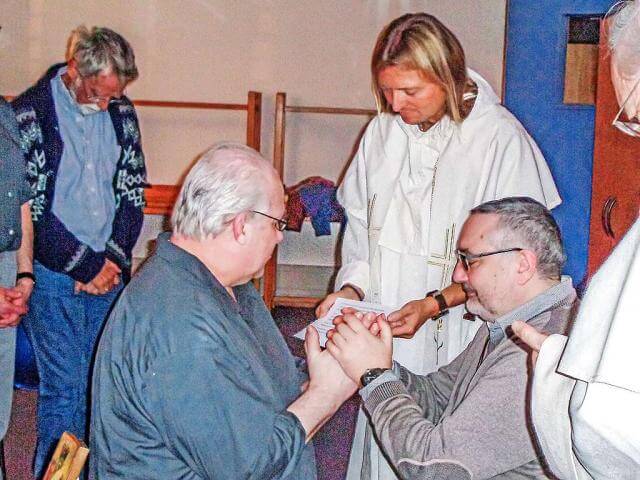
What is it like to be a "cloistered brother" inside prison walls? Here's a taste, written by a "cloistered brother" who happens to be the president of the prison Lay Dominican Fraternity.
Imagine yourself standing on a very crowded beach. You look out to the horizon and see a massive tsunami wave lifting high into the sky as it rushes toward you with the speed of a bullet train. Pressed in between the throngs of bodies on the beach, you turn to run. As you lift your knee to begin your panicked sprint, you feel the painful yank of a heavy chain. As you do so, you realize that all the other densely packed people on the beach are trapped the same as you. You scream and yell, but your voice is lost in the cacophony of cries rising from the beach. You turn your head to check the wave's progress. It has now climbed far above the horizon and looks like a watery bulldozer blade plowing toward you. You return to frantically pulling the chain latched to your ankle. A shadow climbs over you as the wave eclipses the sun. You turn back toward the violent wave, as does everyone else on the beach. Shrieks fade into pure silence. You close your eyes and wait for the inevitable.
This is what it feels like to be in prison during the Coronavirus.
More than 2.2 million women and men are trapped on the beach that is the American criminal punishment system. Prisoners like me are in a position where all we can do is wait for the wave to hit us.
When I look out my window, I see staff walking back and forth bringing food, medication, and supplies. Some are wearing protective gear, others are not. They are one part of the viral tsunami. When the virus comes in, it will come in through them.
The other part of the wave is the structure of the prison itself. We are strategically packed into units, housing blocks, and facilities like products in an Amazon warehouse. For example, where I am, there
are men stuck in two-man cells the size of a parking space. There are other men in four-man cells that are not much larger. Other prisons have six-man cells and dormitories filled with bunks that hold hundreds. When the virus hits these places, it will hit hard.
The biggest challenge I have seen in fighting the Coronavirus in the United States has not been a lack of science of a lack of willingness to fight; it has been a lack of imagination. Many Americans simply cannot imagine a pandemic because so few of us have ever experienced one. We have no mental framework to process a mass casualty disease like COVID-19. Therefore, we reach for easy, but inaccurate, parallels like the flu. We cannot visualize an invisible threat causing hundreds of thousands of deaths, so we ignore the images of orange body bags stacking up and wonder when the baseball season might start.
The ramparts built up inside American minds that prevent people from really understanding the threat of the Coronavirus are similar to the blockades that are preventing officials from properly addressing how to treat people in prisons during this crisis. Over the past several weeks, there has been far too much status quo thinking, and it is leading to far too many deaths in prisons.
Politicians and judges, like many citizens, cannot think of another way to handle incarcerated people. This is due mainly to our nation spending more than a century failing to use our imagination to make improvements to the criminal punishment system. Once America settled on the idea of warehousing people, the nation rarely tried to move past the concept toward a better model.
The reality of American prisons in a post-Coronavirus world is that they are no longer a realistic solution. Once we all accept that fact, the quicker we can begin to imagine something else. We need to start that work right now. The virus won't wait, so we cannot wait.
Many of us in this place are not a threat to society. That is not my opinion, that is the studied opinion of the Department of Correction. If I may use myself as an example. I have been in prison for almost fifteen years. During that time, I have actively participated in rehabilitative and educational programs. I have held a steady job. And, I have volunteered my time to help others. As such, the DOC each year gives me an evaluation that reads, "Low Risk." In other words, the state of Massachusetts says that I am not a danger to the community. Yet, they are okay forcing me to remain in a place where I am now in constant danger.
If nothing changes, I and many others will continue to wake up each day to find that we are still trapped on the beach; still locked in place by a heavy chain. We will spend our days scanning the tumultuous and unpredictable horizon wondering if today will be the day the tsunami crashes into us.