Search This Blog

Showing posts with label R.C.I.A.. Show all posts

Sunday, April 9, 2017

A Sign of My Faith

Since my RCIA class was finished early, I dropped by my Protestant friend, Steve's scripture class. They were faith sharing.  The passage was Matt. 20: 1-16, commonly known as the Laborers in the Vineyard.

If you're not using your eyes of faith, but only the eyes of the world, you would slap the owner of the vineyard with an unfair labor practices lawsuit.  But God sees differently and he loves everyone and gives generously.

The parable is meant to give hope.  The believer who professes belief, (like St. Dismas), in his last breath, has every right to be in heaven as the cradle believer.

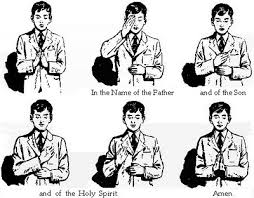
I added my two cents to the class.  We ended in prayer and I made sure I made the sign of my faith--I blessed myself with the sign of the cross.


Thursday, February 18, 2016

R.C.I.A. Lingo

It is easy to see why some people are turned off by RCIA.  New terms and concepts are thrown at them.  Yes, each one is most probably explained, but one doesn't have a chance to get used to a term, understand it, let alone get accustomed to it, before another is introduced.

First of all, the man or woman trying to understand what Catholicism is all about is referred to R.C.I.A.  They may have asked what RCIA meant and told that it's an abbreviation for Rite of Christian Initiation of Adults, but that might immediately pass through the ears, because it's not used in its long form.  It is the most frequent question asked, and that's not by the newbies, it's asked, every single year by the same "cradle Catholics" --What's RCIA stand for, again?

Next, these newbies are called:
       Inquirers
       Candidates
       Neophytes
       Precatechumenate

They are instructed by:
     catechists
     sponsors

They learn they will need:
        rites
      godparents
      sponsors

They will receive:
      Sacraments of Initiation:
             Baptism
             Eucharist
             Confirmation

If they are baptized they are then called:
        candidates
However, if they are NOT baptized they are called:
        catechumen

Confused yet?

After Ash Wednesday, there is:
        Rite of Election
by the way, from the first Sunday in Lent to Easter is
called a period of Purification and Enlightenment

First Sunday of Lent is this Rite of Election so they are called:
        The Elect

Stay with me.

The Elect publically declare their intention to join the Catholic Church.
Their names and the names of their godparents are written in the Book
of the Elect. With prayers of support from the entire congregation, the
Elect now begin the last and most intensive weeks on the way to becoming
fully Catholics.

Every Sunday during Lent the Creed and Lord's prayer will be recited to
have the Elect recite.  The Third, Fourth and Fifth Sundays of Lent, special
rites called scrutinies will be read. Scrutinies are special prays for understanding
and purification.

Holy Week begins with Palm Sunday.  The Elect join with the parishioners in
a
procession, waving palm branches recalling Jesus triumphal entry into Jerusalem.

The last three days of Holy Week are called the Triduum--Holy Thursday, Good Friday, and Holy Saturday.
       Holy Thursday--The Elect participate in getting their feet washed.
       Good Friday--The Elect meditate upon the death of Jesus.
       Holy Saturday--Finally, amidst long ceremonies, the Elect come to the fullness of Christian initiation.  They receive a solemn blessing, are baptized, and receive the Eucharist.  Confirmation comes at a later date, although sometimes depending on circumstances, the priest may confirm the newly baptized Christians, after baptism.

Now at last, if you are still with me, everyone celebrates the blessing of belonging to the Catholic Church.  Thanks be to God.
Friday, December 4, 2015

Worshipping Mary

An experienced trial attorney will never ask a question that he doesn't already know the answer.  I know that.  I also learned today that sometimes the responder doesn't know what you know.  What am I talking about?

A few days ago, I posted about my R.C.I.A. class.  I planned on introducing Mary.  I did this.  The catechumenate said that they had heard that Catholics worshiped Mary.  I told them that we don't.  I was surprised when I asked them since they have been attending Mass, and are friends with some Catholics, do they, themselves, think we worship Mary, and they said, "yes."  Some added, "Well maybe," "It looks like that."

I tried to explain that we worship God, and honor Mary, and why we honor Mary.  They didn't see much difference in the meanings of worship/honor/reverence.  Once we agreed on the differentiations between worship and honor, they could see the difference between the way Catholics think and pray to God and Mary.

But the devil intervened.  Francisco walked in.  Francisco teaches R.C.I.A. to the Spanish class.  I asked my confrere, "Francisco, do you worship Mary?"

Immediately, Francisco responded, "Si."

My jaw hit the floor.

Francisco could tell by my expression that he gave the wrong answer.  But he didn't know why.  I explained, "No we honor Mary and we worship God."  He said "yes."  That was what he meant.  Francisco's problem was that his first language is Spanish and these particular words: honor, revere, worship, and devotion, have different nuances to them that English doesn't convey.

For example, Francisco objected to the expression, "having a great devotion to Mary," because in Spanish, devotion is a word connected to God, alone.  In English, people can be devoted to people and animals and even ideas.

I don't know if the catechumenate understood this Marian concept, but I know that I learned why non-Catholics think that Catholics worship Mary.  


Monday, August 10, 2015

A Letter from Jesus

Last week one of my R.C.I.A. candidates asked me a question I had never thought of.  This is my candidate that was a Wiccan.  As a wiccan, he didn't believe in Jesus.  So my job is to convince him that Jesus is who He says He is.  Well, my inquirer asked, "How come Jesus never wrote anything?"  He went on to elaborate about how common sense would demand that someone as important as Jesus would leave a paper trail.

The answer boils down to the culture of the times.  Jesus' culture was "oral".  They told stories and passed them down.  Besides, where would Jesus have gotten the paper to write.  Papyrus and animal skins were expensive and nobody from Jesus' strata could have gotten ahold of them.  Also, why would you want to write to people who didn't know how to read?

Someone also expressed the thought that people thought the world was going to end soon, so why worry about leaving a paper trail?

Not Ship-Shape

  The Woman in Cabin 10 b y Ruth Ware is called a psychological thriller.  To me it means that the protagonist, Lauren, will drive you crazy...