Search This Blog

Sunday, October 13, 2019

The Prayer Group is Back

It's been almost five years since Father Diotrophes had a run-in with those people.  A quiet peace had descended upon the parish. Probably because the leader of the prayer group had saved his life.  Although it could have been his prayers.  Father Diotrophes had been praying for patience with the prayer group.  Prayer works, that's for sure.  Anyway, he just about forgot about them.

On this particular Sunday, Father Diotrophes was looking forward to the Women Club's Bake Sale.
He was always the beneficiary of some of the leftovers.  He usually gifted with his choice of whatever he wanted.

Finally, the last Mass on Sunday was finished and he meandered over to the bake sale.  But what did he find?

Nothing.

??????????

"Oh, Father Diotrophes what a blessing!  We sold everything!"

"Everything?"

"Yes, the prayer group bought everything that was left, to bring them over to the Town's Department of Public Works' Garage.  The town workers will enjoy our baked goods on their break.  Isn't that thoughtful?"

Father Diotrophes was silent.  He might have grunted an assent.  (I think.)

Always Do Your Best

Today I noticed that the angels above the altar are different.  From the pews, looking up, one may think they are the same but look closer at their faces.  Their hair is different.  One has bangs and although both have long hair, they fall on their shoulders differently.  And it may be me, but I think their expressions differ slightly.

This reminded me of a story about Jose Maria Escriva.  I heard that to explain how every person should always do their best, he would bring them up to the top of Notre Dame in Paris.  Once up there in the very heights of the tallest buildings in the city, he would point out the statues on top, gargoyles, and design curlycues, on the roof.  No one could see the details in each one of those fixtures.  Yet, the artist made each one different.  What difference did it make?  The people from the street couldn't see any difference.  But to the artist, it was important.  He wanted his skill and talent to be obvious so he always did his best whether others would appreciate his work, or not.

Shouldn't we always try to do our best? Not only is this a good habit to cultivate, but it would please God.  He made us and gave each one of us everything we have.  We should strive to use God's blessings to their utmost, always.

Saturday, October 12, 2019

Washed Clean

Lectio:

Twenty-eighth Sunday in Ordinary Time
Lectionary: 144


Reading 12 KGS 5:14-17

Naaman went down and plunged into the Jordan seven times
at the word of Elisha, the man of God.
His flesh became again like the flesh of a little child,
and he was clean of his leprosy.

Naaman returned with his whole retinue to the man of God.
On his arrival he stood before Elisha and said,
"Now I know that there is no God in all the earth,
except in Israel.
Please accept a gift from your servant."

Elisha replied, "As the LORD lives whom I serve, I will not take it;"
and despite Naaman's urging, he still refused.
Naaman said: "If you will not accept,
please let me, your servant, have two mule-loads of earth,
for I will no longer offer holocaust or sacrifice
to any other god except to the LORD."
Studium:
Naaman, an army commander had leprosy and had tried many cures.  None worked.  His wife's servant, an Israeli, recommended that Naaman present himself to Elisha, the prophet in Israel for advice. At first, Naaman wasn't going to do this but he was desperate to try anything.  So he went to Elisha.  When Elisha told Naaman to dunk himself into the Jordan, he thought he was kidding.  Naaman even wondered if Elisha was making fun of him.  But at the urging of his wife and her servant, he gave it a try.  This is the background to 2 Kings 5: 14-17.
Meditatio:
Well, I know the shame associated with illness and its associated desperation.  The desperation forces one to overcome the shame. Naaman, as I, appealed to God for help.  Naaman was not Israeli and worshipped other gods, but when Elisha's God cured him when nothing else worked, Naaman became a believer.  My faith was strengthened as I became healthier and healthier.  To God belongs the glory.
Oratio:
More importantly, was Naaman's inner change.  Before encountering God's power he was arrogant and proud.  When meeting the mercy of God, Naaman was humbled and thankful.  Naaman saw and believed.
Contemplatio:
Lord, give all the grace to believe.  Heal all who come to you that they may be humbled and grateful.
Resolutio:
My prayers tonight will be thanksgiving for my many blessings.


Monday, October 7, 2019

How about Raping People Who Rape?

We kill people who kill people?  Why don't we rape people who rape? 

One reason I think, is that we don't want to be personally involved.  When capital punishment is involved it's not a human being touching another human.  It' may be an injection, an electric chair, a guillotine, etc., not the bare hands of a human.  Doesn't that tell you that it's not natural?

The concept of capital punishment may seem acceptable until you get personally involved.  That's a whole different story.  Then you think, is it necessary?

Exactly!


Sunday, October 6, 2019

A Gospel Prayer

Image result for Our Lady of the Rosary ImageWhen people pray the Rosary, they meditate on particular stories of the life of Jesus and Mary.  But they are called mysteries.  Why? I don't know but they are.  Mysteries = Stories.

There are five images in the Joyful Mysteries: Annunciation, Visitation, Nativity, Presentation, and the Finding of Jesus in the Temple.

There are five images in the Sorrowful Mysteries: Agony in the Garden, Scourging, Crowning with thorns, Carry the Cross, and Jesus' Death.

There are five Luminous Mysteries: Baptism of Jesus, Wedding at Cana, Preaching the Kingdom of God, Transfiguration, and the Eucharist.

There are five Glorious Mysteries: Resurrection, Ascension, Descent of the Holy Spirit, Assumption of Mary, and the Crowning of Mary as Queen of Heaven.

Meditating upon these events in the lives of Jesus and Mary is why the Rosary is called a Gospel Prayer.

Friday, October 4, 2019

Off the Derech.


In Jerusalem Maiden, Pierre once told Esther that he felt lucky that he wasn't born one of the chosen people. This is taken out of context, especially when you take into account that he was an illegitimate child. He felt lucky to be born free of social constraints, never mind religious rules, traditions, and expectations.

 But Esther was born one of the chosen people. Unfortunately, the author, Talia Carner, paints the Heredi Jews in an unfavorable light. The picture she paints of these ultra-Orthodox Jews is unflattering. And Esther breaks free for a time and is punished--at least she feels that her brief escape caused the punishment. That's also painted as backward thinking.

Contrast the dark Jewish view against the colorful light of the artist's section of Paris and the sexual allure of Pierre, and the chosen people don't look so chosen, do they?


Wednesday, October 2, 2019

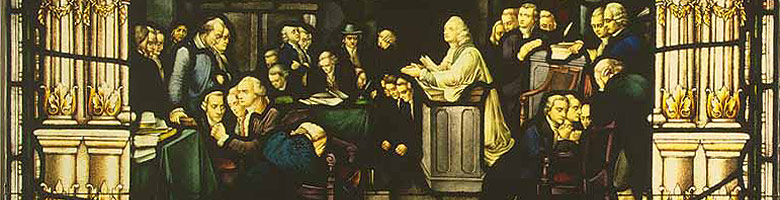
Prayer from the First Continental Congress

Image from Boston Tea Party Museum         

Monday night, my "cloistered brothers" and I were discussing our favorite psalms.  James said his favorite psalm was Psalm 35, the one that was prayed at the First Continental Congress, in 1774. 

I didn't know this.  James also continued by explaining how theology grows and this psalm is an example.  He was trying to tell us that Psalm 35 meant something different in 1774 than it does now, 2019.

The psalm was written in the political climate of the Hebrews, i.e., war, exile, battles, suppression, etc.  It was given to the First Continental Congress in the political climate of war.  The country was trying to throw off the English government, so there was that in common--oppression.  But reading it now, is by far, very dissimilar.

Because the psalm deals with David's prayer to a just God appealing that his enemies be punished and he be avenged, the colonists identified with that psalm. Today, however, we can't imagine a just God taking vengeance on anyone.

I don't think David et al believed in an afterlife.  They prayed for justice in their present situations.  I can't imagine them praying, "Thy will be done."  Remember David believes in "eye for eye" justice.

I won't copy Palm 35 for you.  It's long and monotonously boring.  But I'll point out a few things.  Psalm 35 is a lament.  The psalmist prays that his enemies, the evildoers be publically vindicated.  He wants them punished--quickly.  It is a prayer that is vindictive.

At least the psalmist believes that God is omnipotent.


Rabbi

 Did you ever wonder why a simple carpenter was called Rabbi?  A rabbi is a teacher, a master in spiritual things.  And it wasn't just H...