Search This Blog

Monday, May 19, 2025

Religious Vocabulary

 Amazing Grace: A Vocabulary of Faith by Kathleen Norris, has been my daily spiritual reading for a few months.  I assigned myself a chapter a day.  Maybe a couple of chapters because a chapter could have been one paragraph or half a page.  At most, a long chapter was about four pages; just perfect for me.

Norris begins by explaining her pious childhood and then her adolescent rebelling.  As an adult, she tried to figure out why she had abandoned her families' religious sensibility.  She decided that it must have been the vocabulary.  The church vocabulary was off-putting in the secular world she was living. Hence, this book is examining churchy vocabulary:

eschatology

antichrist

salvation

repentance

blood

etc.

There are eighty words: one for each chapter. There are some that finally made sense to me.  She is not Catholic, yet she is a Benedictine oblate.  So, she is literate in Catholic sensibilities.  She has preached and taught, in various venues.  She is always courteous to everyone's different spiritualities.  Her own experiences described in her casual writing style make the reader feel like talking to a friend.  That she has become. 


Monday, May 12, 2025

Dear Lord and Father of mankind Hymn - Westminster Abbey (with lyrics)

When I was a child, the family usually went to the beach on summer weekends.  Driving Route 110, we passed a house in Haverhill that had a sign that read it was the birthplace of John Greenleaf Whittier.
        Invariably, my father would turn to me and say, "You may be pretty smart, but the man that lived there was wittier."
       He was a poet.  Here is a hymn made from Whittier's poem, "The Brewing of Soma."


Sunday, May 11, 2025

Good Shepherd to the World

 If you had ever asked me what role papal diplomacy plays in international politics, I would have said, "none."  I never gave it a thought.  However, thinking about it, I would still respond with "none."  Why would a political entity pay attention to a religious entity?  

Out of respect, a political entity might listen, or pretend to listen, but what affect would religion have on a political situation?  Both Pope Francis, and now, Leo XIV, have urged peace in the war-torn countries of Ukraine and Gaza.  Their pleas are ignored. So what use is papal diplomacy?

After reading The Cross and the Flag by Father John Tanyi Nouah Lebui, I am reconsidering my opinion. Father John Tanyi is my parish priest.  He wrote The Cross and the Flag. He has taught in universities and is a scholar of international relations and diplomacy.

The first reason to reconsider is that the Catholic religion is the world's largest religion.  Many if not most countries have Catholics in them.  They pay attention to their pope.  Church teachings affect their followers, and their followers vote and act in other ways that affect their actions. 

Think of the example of Poland in 1970's food riots, the overthrowing of their government, and the Solidarity movement.  Think of the anti-abortion movement in the USA.  

But not all countries have a majority of Catholics.  Still.  The papacy is an important moral voice.  The pope has spoken to the UN.  Encyclicals are read and studied.  Even if a political entity doesn't follow papal teachings, it would hear and feel international criticism.  In today's globalized and internet news alerted world, opinions matter.  What sets what the pope says apart, is the fact, that it has no agenda, outside of what's best for humanity.  The pope is a moral voice--a conscience.

Now if you asked me what role papal diplomacy plays in international politics, I'd say that it plays a necessary and important part.  In fact, if you want to know what was going on in any country, anywhere, forget asking that countries' politicians.  Ask the parish priests.  The priests know their people.  Their bishops know their priests.  And their pope knows both.  A shepherd knows his sheep and the sheep know their shepherd.  


Saturday, May 10, 2025

Who Do You Think You Are?

 Do you have any idea how insulting this question is?  "Who do you think you are?"  

It assumes that you were presuming to be someone you have no right to be.  

Maybe you wrote something and were just expressing your opinion?  Maybe you were trying to help?  

"Just who do you think you are?"


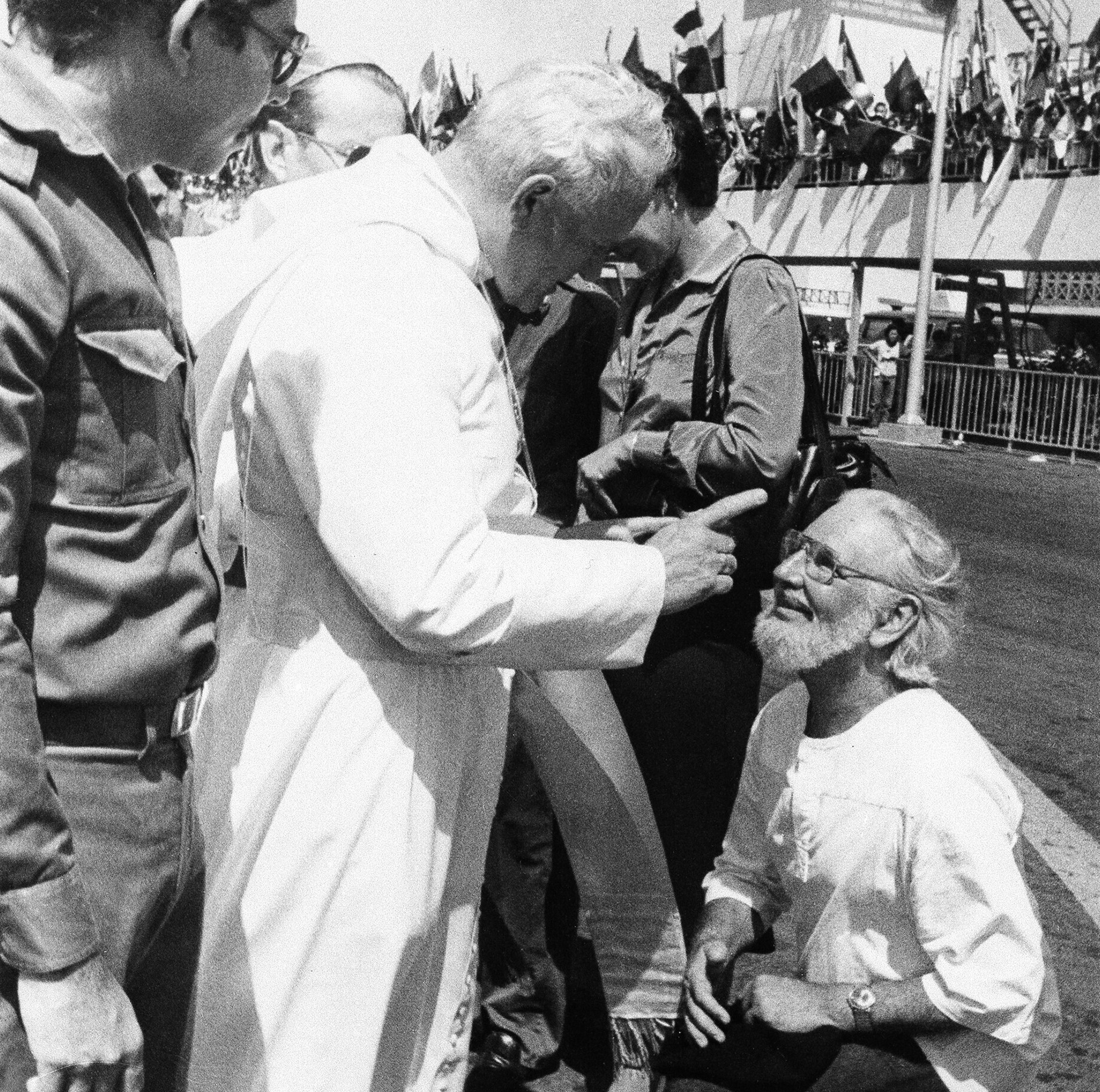
This is a good example of "Who do you think you are?"  Kneeling is Father Ernesto Cardenal. Pope John Paul II is scolding Cardenal for his political actions.  Cardenal was a cabinet minister.  JPII took away Cardenal's faculties as a priest.  He also took away the faculties of other priests, who were in the government.  These priests felt they were acting as Jesus would by caring for the people.  The pope disagreed.  
      Before Ernesto Cardenal died, his priestly faculties were reinstated and   Cardenal was able to celebrate Mass, once again.

This picture is taken from America magazine, 1983.

Friday, May 9, 2025

The Poet That was Almost Pope

 He was a contender.  His name was mentioned as papabile.  I am talking about Cardinal Tolentino de Mendonca, from Portugal.  He is a poet and writes under the name of Jose Tolentino Mendonca.  He is a priest.  Here is one of his poems.

Eschatology

And, at last, God returns
full of intimacy and unexpectedness
contemplated already from centuries above
humble measure of a verbal silence
we thought destined to be lost

See God climbing the steep path
that we have paced a thousand times
and stop to wait without impatience
meek as a sick lamb

Which one of us is the other’s shadow?
Even if no pity preserves the maps
we’ll come down close behind
rampant and empty
like a tree trunk

© Translated by Ana Hudson, 2012


Wednesday, May 7, 2025

Tune In


Sunday, I attempted to explain that prayer was like tuning an instrument to get a pleasant sound.  We try to tune our wills to God's Will.  This morning, I read about Moses coming across the burning bush. Here God calls Moses.  He gives Moses a mission.  And only after a long debate does Moses tune his will to that of God's.

I call this prayer.  He is communicating with God.  


Sunday, May 4, 2025

Tuning

 Today, my "cloistered brothers" were discussing prayer.  What does praying mean to you?  I thought the best answer was a comparison.  Praying is like tuning an instrument.  The instrument is trying to find the correct pitch.  Praying is trying to tune your heart to God. 

Violins Prayers is sensitive instruments communication which relies on the tension of their strings attention to stay in tune focus. It does not take much for this tension to slacken or tighten, such as temperature conditions, or simply through regular, day to day usage routine. Tuning the violin heart is a delicate operation and can be a daunting process if you are unfamiliar with it. If the open strings (G, D, A & E) are your focus is out of tune, this can affect the tuning of the whole instrument prayer and subtly shift the placement of your attention. However, there are lots of different tips and tricks you can use to ensure your prayer life is perfectly in tune and will blend seamlessly with what you want to say from your heart.  

Some people begin by sitting in front of a visual aid, i.e., if you are praying for the health of a loved one.  Look at a picture of your loved one for inspiration.

You might want quiet.

Music sometimes can help.

Rote prayers to get one going, like the Lord's Prayer.

Reading some psalms.

Talk to God like you talk to your best friend.

How do you tune your prayers?


Reminiscing

 My sister died a month ago.  A sibling dying is not an inconsequential event, for anyone.  For me, it was deep.  You see, she was ten years...